
Lambda Supply Chain Listed as a Representative Vendor in Gartner® Market Guide for Supply Chain Network Design Tools
Published April 2026
Subscribe to receive latest resources on supply chain design
Artificial intelligence is rapidly transforming how decisions are made across industries. From automation to predictive insights, AI is no longer just an enabler-it is becoming a core part of how organizations operate.
In supply chains, this shift is redefining how teams expect to work. Insights are no longer something you wait for-they are something you should be able to access instantly, explore interactively, and act on with confidence.
Supply chain analysis is critical-but let’s be honest, it hasn’t always been easy.
Teams often struggle with:
Even experienced analysts spend significant time just getting to the answer, instead of acting on it.
The real bottleneck is no longer data or models-it’s how quickly teams can extract answers from them.
In a world where supply chains are becoming more dynamic and unpredictable, this delay isn’t just inconvenient—it’s costly.
At Lambda Supply Chain Solutions, we believe that accessing insights should be as simple as asking a question.
That’s why we built Optalk-an AI agent designed specifically to interact with supply chain models and answer analytical questions directly.
Optalk allows users to engage with models through a conversational interface-without manual configuration, data preparation, or technical setup.
Just ask your question and get the answer.
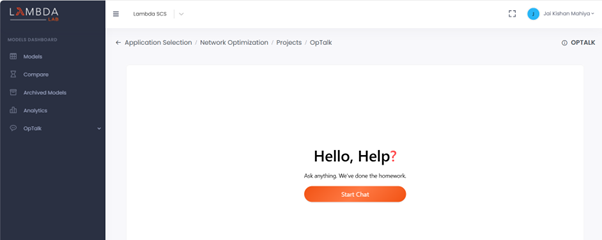
What makes it even more powerful is its seamless integration within the Project section, allowing it to be applied across any model. This ensures consistency, scalability, and ease of use across the organization.
Optalk transforms how users interact with supply chain models by automating the entire analytical workflow behind the scenes.
Here’s what it enables:
Ask questions like:
…and receive structured, model-driven answers instantly.
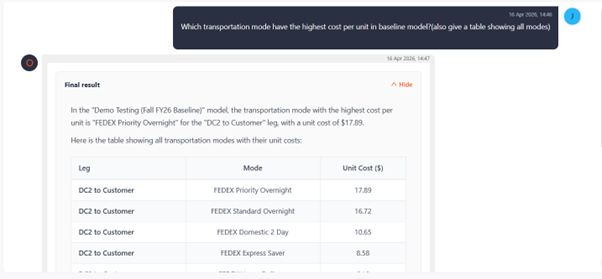
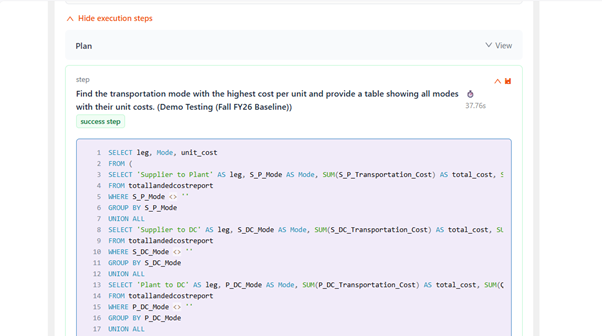
Optalk handles the entire analytical workflow behind the scenes.
When a user asks a question, it automatically:
Users don’t need to navigate models, configure inputs, or run multiple steps—the system takes care of it end-to-end. This becomes especially powerful in large projects where multiple scenarios, versions, and models exist.
Since it is embedded within the Project section, the same capability can be applied across different models and use cases seamlessly.
What used to take minutes or even hours-now takes seconds.
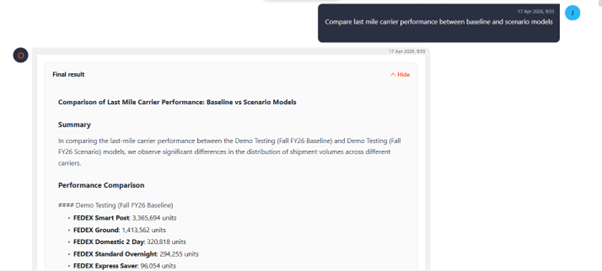
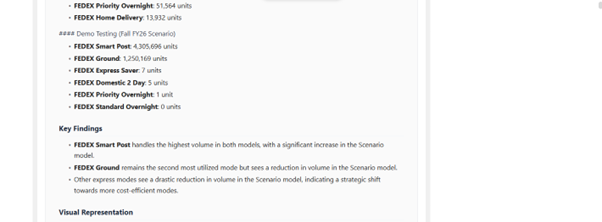
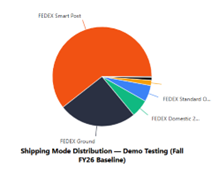
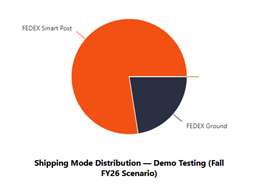
Optalk doesn’t just improve efficiency-it fundamentally changes how supply chain teams interact with data and models.
Before Optalk:
Even simple questions often required multiple steps-extracting data, validating it, and manually analyzing results before arriving at an answer.
With Optalk:
This shift removes the friction between data and decisions-allowing teams to focus less on analysis effort and more on action.
For supply chain leaders, the impact goes beyond faster analysis—it changes how decisions are made across the organization.
In a dynamic supply chain environment, this shift from delayed insights to real-time understanding becomes a significant competitive advantage.
Optalk is just the beginning.
As AI continues to evolve, the direction is clear:
The goal is simple: make interacting with complex supply chain models as natural and immediate as having a conversation.
Supply chains don’t wait-and neither should insights.
With Optalk, we’re moving from a world of manual effort and delayed answers to one where intelligence is instant, accessible, and actionable —helping teams get more value from our Supply Chain Network Design Software.
Ask. Understand. Decide. All in seconds.