Route Intelligence: Smarter Routing Decisions for Efficient Supply Chains
Published June 2026
Table of Contents
Subscribe to receive latest resources on supply chain design
Route Intelligence: From Route Planning to Smarter Delivery Decisions
A Shift We’re Seeing Across Supply Chains
As supply chains become more dynamic and complex, delivery performance is no longer just an operational metric it is a direct driver of cost, service levels, and overall efficiency.
Across industries whether in last-mile delivery, inter-facility distribution, or field service we’re seeing the same pattern: routing decisions are becoming more critical, yet harder to get right.
The challenge is no longer just planning routes. It’s making the right routing decisions under real-world constraints.
Where Traditional Routing Breaks Down
In many organizations, route planning still relies on static systems or manual processes. On paper, these plans appear efficient but in execution, the gaps become clear.
Routes are often generated once, based on fixed assumptions, without accounting for changing demand, operational variability, or real-world constraints.
What we consistently see as a result:
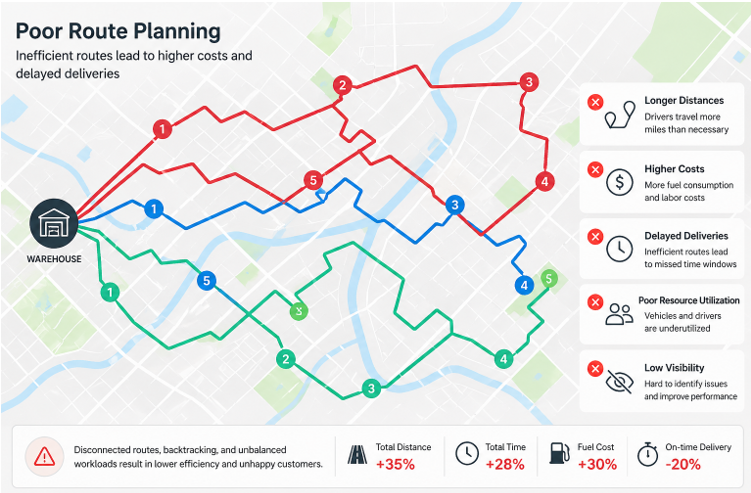
Unnecessary distance and backtracking
Missed delivery windows due to poor sequencing
Underutilized fleets and unbalanced workloads
Rising fuel, labour, and operational costs
These inefficiencies are rarely visible during planning but become evident in execution.
Illustrative AI-generated visual for conceptual understanding
The Shift from Planning to Intelligence
What’s changing now is not just the tools but the expectation.
Routing is no longer a one-time planning activity. It is becoming a continuous decision process.
Leading organizations are moving toward systems that can:
Evaluate multiple constraints simultaneously
Balance cost and service trade-offs
Adapt to changing demand and conditions
Enable scenario-based planning before execution
This is what we refer to as route intelligence.
How We’re Approaching This at Lambda
At Lambda Supply Chain, we’ve built Lambda Vantis to address this exact shift.
Instead of relying on static inputs, Lambda Vantis uses constraint-based optimization to generate routing plans that reflect real operational conditions such as capacity, delivery windows, and service priorities.
More importantly, it allows teams to go beyond a single plan.
Teams can test different routing strategies such as adjusting fleet size, modifying delivery windows, or reassigning territories and understand how those decisions impact cost, delivery performance, and resource utilization before execution.
This moves routing from planning to informed decision-making.
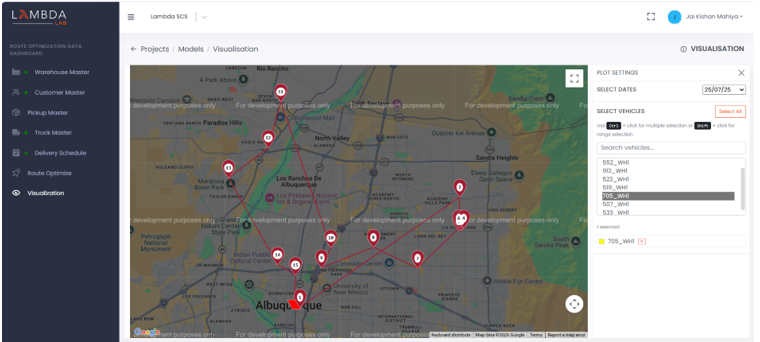
Optimized route plan generated using constraint-based routing across multiple vehicles and delivery points
What This Looks Like in Practice
A common example we see is during demand surges or operational disruptions.
Instead of reacting with fixed routing plans, teams use Lambda Vantis to simulate alternatives:
Should fleet size be increased, or can capacity be optimized?
Can delivery windows be adjusted to improve route density?
How should territories be reassigned to balance workload?
Each option can be evaluated before execution allowing teams to choose the most effective approach with confidence.
What This Means for Operations
The impact of this shift is not incremental it changes how routing decisions are made.
Delivery performance becomes more predictable and reliable
Transportation costs decrease through better route efficiency
Fleet utilization improves without unnecessary expansion
Planning cycles become faster and more responsive
Teams gain the ability to evaluate decisions before executing them
Routing is no longer a static plan—it becomes a continuous optimization loop.
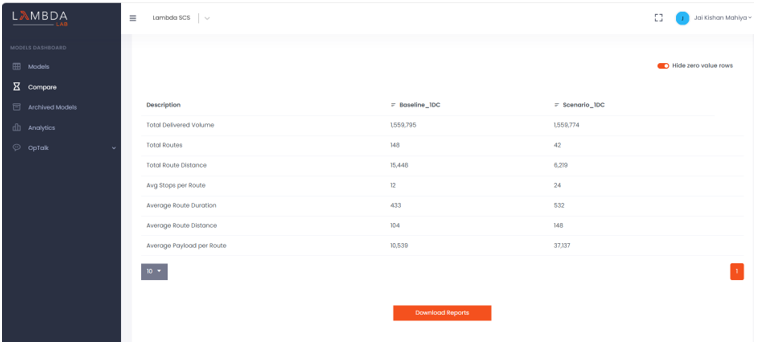
Route performance insights enabling continuous optimization and better decision-making
Final Perspective
What we’re seeing across supply chains is clear: the future of logistics is not defined by better route planning alone.
It is defined by the ability to make better routing decisions faster, more consistently, and at scale
At Lambda Supply Chain, this is the shift we’re focused on enabling.
Because in today’s environment, competitive advantage doesn’t come from having a plan it comes from making the right decisions, repeatedly.
At Lambda Supply Chain, this is the shift we’re focused on enabling.
Because in today’s environment, competitive advantage doesn’t come from having a plan it comes from making the right decisions, repeatedly