
Lambda Supply Chain Listed as a Representative Vendor in Gartner® Market Guide for Supply Chain Network Design Tools
Published July 2026
Subscribe to receive latest resources on supply chain design
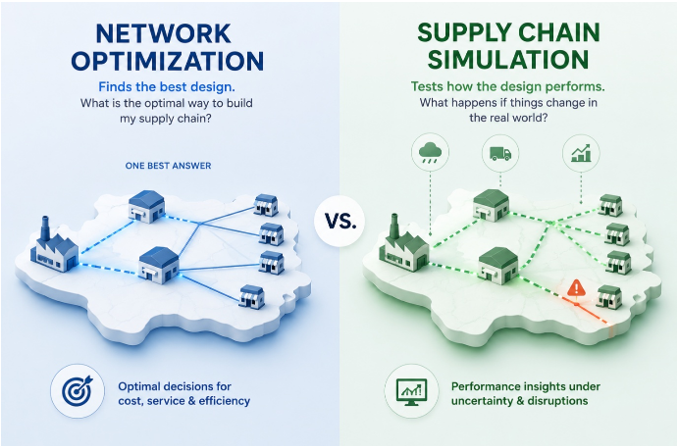
Every supply chain leader faces the same challenge: How do we design a supply chain that is both efficient and resilient?
Supply chain optimization and simulation are two powerful approaches for designing and evaluating modern supply chains. While optimization helps organizations identify the best network configuration based on cost, service, and operational constraints, simulation helps them understand how that network will perform under real-world uncertainty.
Should you open another distribution center? Can transportation costs be reduced without affecting customer service? What happens if customer demand suddenly spikes by 25% or a supplier experience delay or warehouse get out of service?
Answering these questions requires more than intuition. It requires technology that helps organizations evaluate different decisions before making expensive real-world changes.
This is where Supply chain Network Optimization and Simulation come in.
Although these terms are often used together, they solve different business problems. Understanding the difference helps organizations make smarter, more confident supply chain decisions.
Network optimization is the process of finding the best possible supply chain design based on business objectives and operational constraints.
Instead of manually evaluating a handful of scenarios, optimization algorithms can analyze thousands or even millions of possible network configurations to identify the solution that delivers the best balance of cost, service, and efficiency.
Typical optimization decisions include:
The objective may be to minimize transportation costs, reduce inventory, improve service levels, lower carbon emissions, or balance several business goals simultaneously.
Think of optimization as answering one question:
“What is the best network for my business objectives?”
Simulation answers a different question.
Instead of searching for the best design, simulation evaluates how a supply chain performs under realistic operating conditions.
A simulation creates a digital representation of your supply chain and runs it over time while introducing variability such as changing demand, transportation delays, production constraints, equipment failures, or supplier or warehouse disruptions.
Simulation helps answer questions like:
Rather than producing a single “best” answer, simulation provides insight into how a network behaves under different scenarios. Like if warehouse closes how much cost increase will happen in the whole network and where should this impact the most
Think of simulation as answering:
“What happens if this network operates in the real world?”
The easiest way to understand the difference is this:
Optimization designs the supply chain. Simulation stress-tests the design.
Imagine planning a road trip.
Optimization finds the fastest route to your destination.
Simulation asks what happens if traffic increases, roads close, or the weather changes.
Both are valuable but they answer different questions.
Imagine a retail company planning to expand across United States
After analyzing demand, transportation costs, and customer locations, network optimization recommends opening four distribution centers.
The recommendation reduces annual logistics costs by 14%.
At first glance, the decision looks perfect.
But before investing millions, the company runs a simulation.
The results reveal that:
The optimized network is still strong—but simulation uncovers operational risks that were not obvious during the optimization process.
Instead of discovering these problems after implementation, the company identifies them before making the investment.
|
Supply Chain Network Optimization |
Supply Chain Simulation |
|
Finds the best solution |
Evaluates how a solution performs |
|
Mathematical optimization |
Event-based or time-based simulation |
|
Strategic planning |
Operational validation |
|
Minimizes cost and improves efficiency |
Measures resilience and operational performance |
|
Produces recommended designs |
Produces performance insights under different scenarios |
The most effective supply chain teams don’t choose between optimization and simulation—they combine them.
A typical decision-making process looks like this:
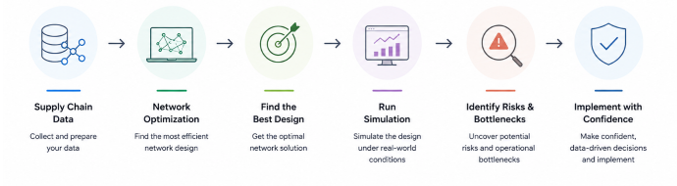
Optimization identifies the most efficient network.
Simulation confirms that the network can withstand real-world variability.
Together, they enable organizations to make decisions that are not only cost-effective but also resilient.
If your question is… | Use… |
Where should we open our next distribution center? | Network Optimization |
Can our current network handle a 30% demand increase? | Simulation |
Which transportation strategy minimizes cost? | Network Optimization |
What happens if a supplier is delayed by three days? | Simulation |
How can we reduce logistics costs? | Network Optimization |
Will our service levels remain stable during peak season? | Simulation |
The best supply chain decisions aren’t made after implementation—they’re made before it.
By combining network optimization with simulation, organizations can identify the best network, validate its performance under real-world conditions, and move forward with confidence.
Lambda Supply Chain combines supply chain network design, optimization, and scenario analysis in a unified decision intelligence platform. Model your network, evaluate different scenarios, and understand the potential impact before making major supply chain decisions.
Model it before you move it.