
Lambda Supply Chain Listed as a Representative Vendor in Gartner® Market Guide for Supply Chain Network Design Tools
Published Oct 2026
Subscribe to receive latest resources on supply chain design
Supply Chain Planning is the process of aligning expected demand with available supply, inventory, materials, production resources, and distribution requirements to meet business objectives.
It helps businesses answer important questions: What will customers need? How much inventory should be available? Can suppliers and production facilities meet expected demand? What needs to be purchased or produced, and when?
Supply chain planning includes several connected activities:
Depending on the business, planning also involves procurement, distribution, and coordination between commercial and operational teams.
These activities are interconnected. Changes in demand affect inventory and production requirements, while supplier availability and production capacity influence how much the business can supply.
Unlike day-to-day supply chain execution, which involves carrying out activities such as purchasing, manufacturing, and moving products, planning looks ahead to determine what needs to happen and whether it is feasible.
The objective is to coordinate these decisions so businesses can meet customer requirements while managing cost, resources, and operational risk.
The importance of supply chain planning becomes clearer when businesses experience problems that cannot be solved by looking at demand, inventory, production, or purchasing in isolation.
Bridge the Gap Between Demand and Supply
Customer demand may exceed available materials or production capacity. Supply chain planning helps businesses identify these gaps early and develop plans that better match demand with available resources.
Make Better Inventory Decisions
Too much inventory increases costs and ties up working capital, while too little can lead to stockouts and delayed orders. Planning helps businesses determine how much inventory is needed to support demand and service requirements.
Identify Constraints Early
Limited production capacity, material shortages, and supplier delays can disrupt operations. Planning helps businesses identify these constraints early and evaluate alternatives before they affect production or customer deliveries.
Prepare for Disruptions
Demand changes, supplier delays, and unexpected downtime can make existing plans outdated. Scenario planning helps businesses evaluate alternatives and prepare for changing conditions.
Improve Coordination Across Teams
Sales, purchasing, manufacturing, and logistics often have different priorities. Supply chain planning helps align their decisions around shared demand, supply, inventory, and capacity requirements.
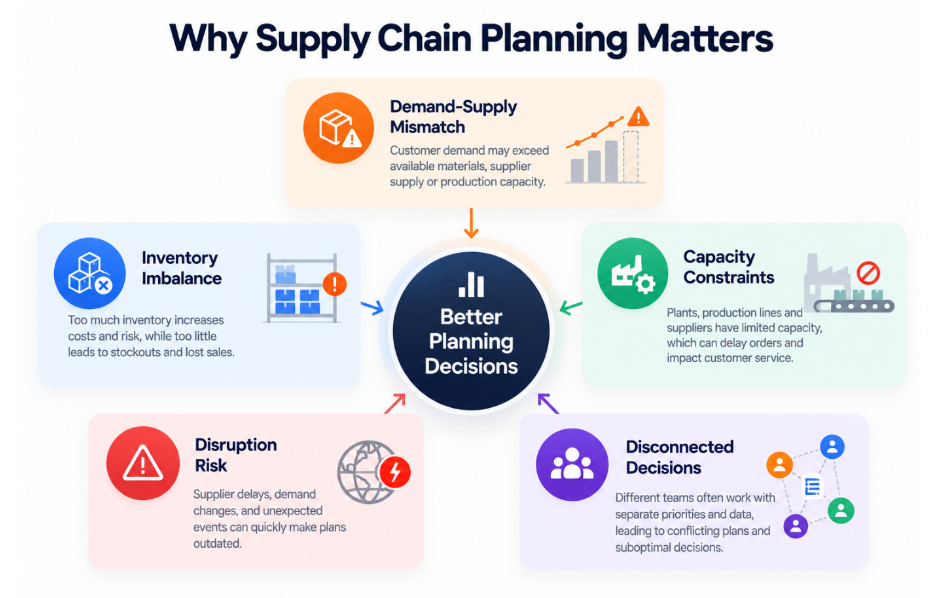
Supply chain planning is valuable not simply because it creates a plan, but it helps businesses improve operational performance, manage financial resources, and make more coordinated decisions.
Improved Customer Service
Better alignment between customer requirements and supply plans helps businesses make more reliable delivery commitments and improve order fulfillment.
Better Inventory and Cost Management
Planning helps businesses balance inventory availability with working capital requirements and understand the cost implications of different purchasing, production, and supply decisions.
Higher Resource Utilization
A clearer view of available supplier, plant, and production-line capacity helps businesses allocate resources more effectively and identify opportunities to improve utilization across their operations.
Greater Resilience and Cross-Functional Alignment
Scenario analysis helps businesses evaluate responses to changing conditions, while shared planning assumptions help sales, procurement, manufacturing, and logistics teams coordinate decisions around common business priorities.
Consider a manufacturer producing several finished goods that share raw materials and production capacity.
Demand for one product is expected to increase over the next few weeks. The initial calculations show how much needs to be produced, but the main production line is already near capacity, and a key raw material will arrive later than required.
The required production volume has been calculated, but the plan is not yet feasible.
The manufacturer needs to determine how to meet demand within its actual operating constraints. Possible options include producing inventory earlier, using another qualified production line, or adjusting production timing to match material availability.
Each option has trade-offs. Producing earlier may increase inventory, while using another line may affect other products. Simply calculating requirements cannot resolve these conflicts.
A constraint-based planning approach evaluates these alternatives against material availability, production capacity, inventory policies, and demand requirements. This helps the team understand which adjustments can produce a feasible plan and what trade-offs they involve.
The key difference is between knowing what needs to be produced and determining what can realistically be produced, when, and with the resources available.
Supply chain planning becomes particularly important when businesses experience recurring problems that are difficult to solve through isolated operational decisions.
our business may need to strengthen its planning approach if:
When these problems occur repeatedly, they may indicate that your planning process cannot effectively connect demand, inventory, supplier availability, and production capacity. Problems can remain hidden until they affect production, customer commitments, or operating costs, leaving fewer and more expensive options to resolve them.
Supply chain planning software helps businesses identify constraints earlier, evaluate alternatives, and turn demand requirements into feasible supply plans reducing reliance on manual fixes and reactive decisions.
As supply chains grow in size and complexity, manually evaluating every product, supplier, production line, and constraint becomes increasingly difficult.
Planning software helps businesses evaluate these relationships in a more structured and consistent way.
Constraint-based planning assesses supply requirements against material availability, production capacity, qualified resources, lead times, and warehouse limits.
Scenario analysis allows teams to examine how plans might change when demand, supplier availability, or production capacity shifts. Instead of immediately changing the operating plan, they can compare alternatives and understand their potential effects.
Plan smoothing helps address conflicts by adjusting quantities or timing, using permitted alternatives, and considering inventory and capacity limits.
Planning visibility and analytics help teams understand which constraints affect a plan, why changes were made, and where exceptions remain. Better access to relevant data can also help teams coordinate decisions across departments.
Technology does not replace business judgment. It helps teams evaluate alternatives, understand their implications, and make better-informed decisions.
Lambda Lab’s Supply Chain Planning software addresses a specific challenge: turning a demand plan into a feasible supply plan across suppliers, plants, and warehouses.
Users load SKU-level demand data and relevant supply chain constraints, create a scenario, and run the model. During execution, the software handles the underlying MRP calculations, constraint checking, and plan smoothing.
The solution considers factors such as production capacity, qualified plant and line capabilities, raw-material availability, warehouse limits, lead times, working calendars, and inventory policies.
Teams can also evaluate what-if scenarios to understand the implications of different planning assumptions and compare results across service, cost, inventory, and capacity utilization.
The resulting production, purchase, and transfer plans can be reviewed alongside exceptions and explanations of the requirements and constraints behind the plan.
Lambda Lab also includes Network Design and Route Design, which support complementary supply chain decisions. Network Design focuses on how the supply chain should be structured, while Route Design supports transportation-network and delivery-route decisions.
With Supply Chain Planning, businesses can move from calculating what they need to understanding how they can meet that need within their operational constraints.
Learn more about Lambda Supply Chain Planning.
Businesses need supply chain planning because demand, inventory, supply, and production cannot be managed effectively in isolation.
A demand forecast does not guarantee material availability. Sufficient inventory does not guarantee production capacity. And a production plan does not guarantee that every customer requirement can be met on time.
Effective planning helps businesses understand these relationships, identify constraints earlier, prepare for disruptions, and make informed decisions about cost, service, inventory, and capacity.
As supply chains face changing customer expectations, market conditions, and operational risks, the ability to develop feasible plans and respond thoughtfully to change becomes increasingly important.
Don’t just plan what you need. Understand how your business can deliver it.