
Ready to Transform Your Supply Chain Network?
Contact us today to learn more about how our Services can drive success for your business.
Lambda Supply Chain Listed as a Representative Vendor in Gartner® Market Guide for Supply Chain Network Design Tools
Published Nov 2026
Subscribe to receive latest resources on supply chain design
Why adding AI features is not the same as running an AI-first supply chain, and how to build one that delivers value instead of hype.
Almost every enterprise now uses AI somewhere in its supply chain. A forecasting model here, a chatbot on top of the ERP there, a pilot that flags late shipments. Yet for many leadership teams, the results still feel small compared with the investment and the noise.
The gap is not the technology. It is the operating model. An AI-first supply chain is not one with more AI tools. It is one where decisions are designed from the start to be sensed, evaluated, and executed with AI, and where people focus on the trade-offs that need judgment.
2027 is the year this distinction starts to matter. Analysts expect agentic AI features to become a standard requirement in supply chain software, while warning that many “autonomous” claims are ahead of reality.
In this guide, we explain what an AI-first supply chain is, how it differs from simply adding AI features, the building blocks it depends on, where AI adds value at each planning level, and a practical example of what changes when decisions are designed around AI.
An AI-first supply chain is an operating model in which AI is built into how supply chain decisions are made and executed, not added afterward as a reporting or productivity layer. Data, planning models, and workflows are designed so that AI can detect what has changed, evaluate the options against real constraints, and either recommend or take action within agreed limits.
In practice, an AI-first supply chain answers questions such as:
The goal is not a supply chain without people. It is a supply chain where routine decisions run faster and more consistently, and where people spend their time on the decisions that matter most.
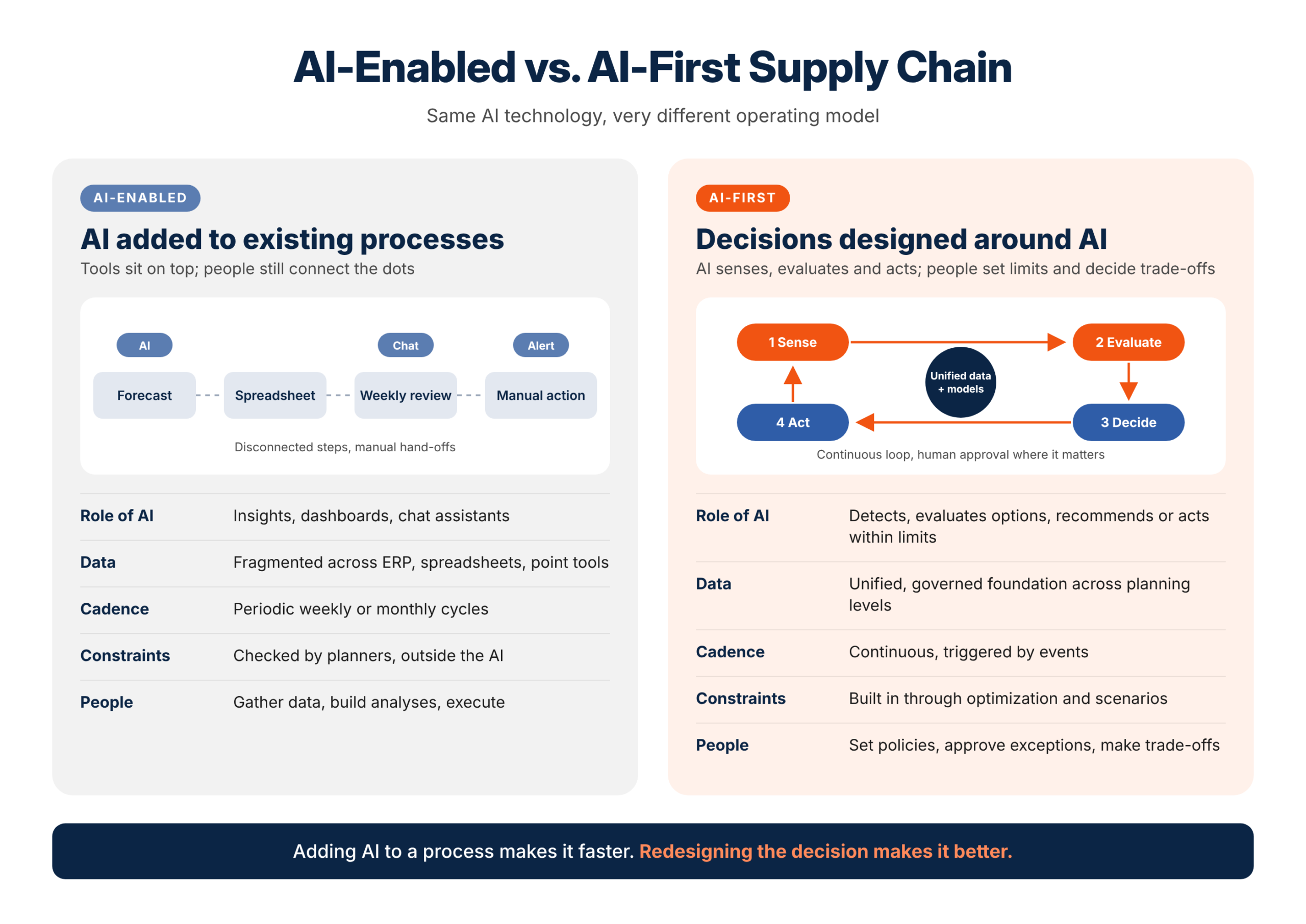
Most enterprises today are AI-enabled. They have added AI tools to existing processes. An AI-first organization redesigns the process around what AI and optimization can do.
| AI-Enabled Supply Chain | AI-First Supply Chain |
Starting point | Existing processes with AI tools added on top | Decisions and workflows redesigned around AI |
Role of AI | Insights, dashboards, chat assistants | Detects, evaluates options, recommends or acts within limits |
Data | Fragmented across ERP, spreadsheets, and point tools | Unified, governed data foundation shared across planning levels |
Planning cadence | Periodic (weekly or monthly cycles) | Continuous, triggered by events |
Constraint handling | Often outside the AI, in planners’ heads or spreadsheets | Built in through optimization and scenario models |
Human role | Gathers data, builds analyses, executes | Sets policies, approves exceptions, makes trade-offs |
Typical result | Isolated pilots with limited enterprise impact | Measurable impact on service, cost, and working capital |
The difference shows up in results. McKinsey’s 2025 State of AI survey found that 88% of organizations regularly use AI in at least one business function, but only about one-third say they have begun scaling it across the enterprise. The small group of high performers was nearly three times as likely as others to have fundamentally redesigned individual workflows (source).
Adding AI to a broken process gives you a faster broken process. Redesigning the decision gives you a better one.
AI Is Becoming a Software Requirement
Gartner forecasts that supply chain management software with agentic AI capabilities will grow from less than $2 billion in spend in 2025 to $53 billion by 2030, and that 60% of enterprises using SCM software will have adopted agentic AI features by 2030, up from 5% in 2025 (source). Enterprises that are not ready to use these features will pay for capabilities they cannot exploit.
Disruption Is Now Routine
Supplier delays, port congestion, tariff changes, and demand swings no longer arrive once a year. They arrive weekly. Gartner predicts that by 2031, 60% of supply chain disruptions will be resolved without human intervention (source). Getting there requires foundations that most organizations need to start building now.
Speed of Decision Is a Competitive Advantage
When one company takes five days to decide how to respond to a supplier delay and a competitor decides the same day, the competitor secures the alternate capacity, the freight, and the customer.
The Workforce Is Changing
In a Gartner survey of 509 supply chain leaders, 55% expected agentic AI to reduce the need to hire for entry-level positions, and 86% agreed it will require new processes for developing future talent (source). Roles are shifting from data gathering to decision-making.
Hype Can Lead to Costly Mistakes
Gartner has also warned of “agent washing,” where conventional automation is relabeled as agentic AI, and said that vendor claims of end-to-end autonomous supply chain planning before 2027 overstate what is possible (source). Leaders need a clear framework to separate real capability from marketing.
An AI-first supply chain is not a single tool. It rests on a set of building blocks that must work together:
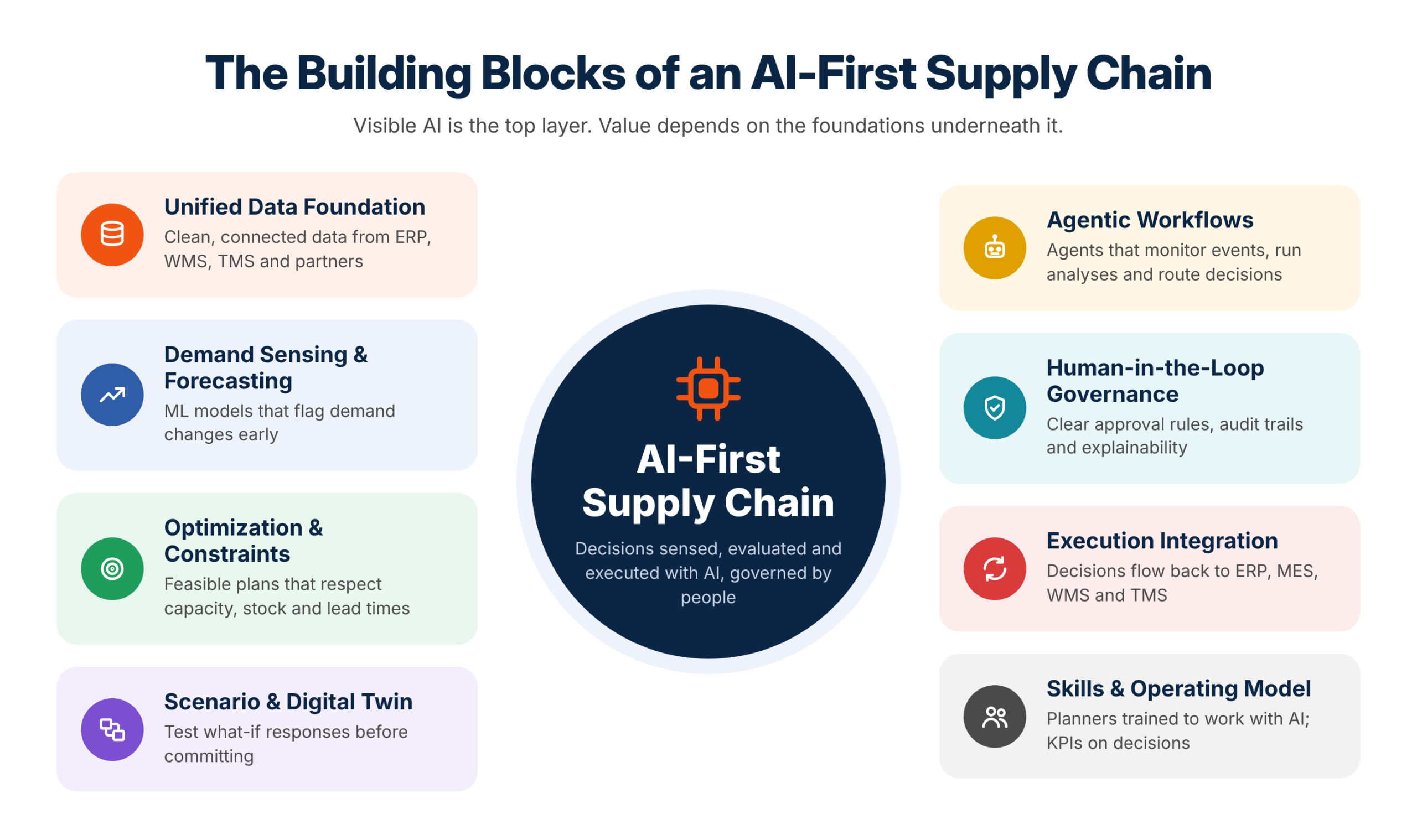
The most common mistake is investing heavily in the visible layer, such as chat assistants and dashboards, while neglecting data, constraint models, and governance. That is why so many pilots never scale.
AI-first does not mean the same thing at every level of the supply chain. The right approach depends on the type of decision.
Strategic: Network Design
Long-term decisions on where to locate plants, warehouses, and suppliers. AI helps prepare and clean data and generate scenarios, while optimization evaluates network options on cost, service, and risk. Humans make the final call. (See our guide to Supply Chain Network Design.)
Tactical: Demand and Supply Planning
Monthly and weekly decisions on what to produce, buy, and move. Machine learning improves forecasts, and constraint-based planning turns them into feasible supply plans. Touchless planning for stable, high-volume items is one of the best early use cases. (See Supply Chain Planning.)
Operational: Scheduling and Routing
Daily and hourly decisions on production sequences and delivery routes. These are high-volume decisions where AI agents and optimization can re-plan quickly when orders, breakdowns, or traffic change. (See Route Optimization.)
Levels of Autonomy
Not every decision should be automated. A useful way to think about it is a ladder: assist (AI summarizes and explains), recommend (AI proposes options with trade-offs), act with approval (AI prepares the action and a planner approves), and act autonomously (AI executes within defined limits and reports back). Most enterprises in 2027 should aim for “recommend” and “act with approval” on most decisions, and autonomous action only on high-volume, low-risk ones.
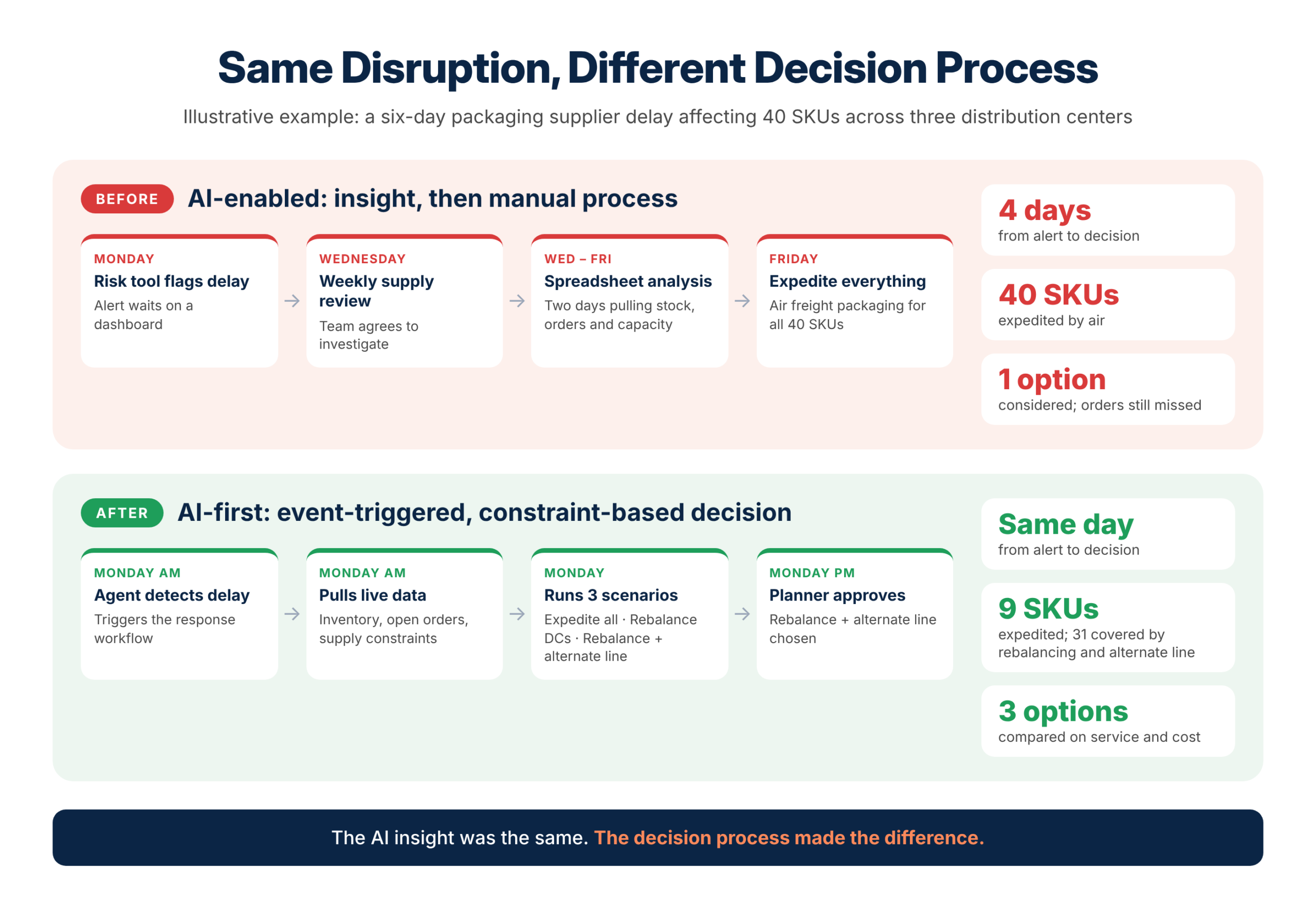
Consider a consumer goods company that distributes through three regional distribution centers. It has invested in AI: a machine learning forecast, a risk-monitoring tool, and a chat assistant on top of its ERP.
On a Monday, a key packaging supplier announces a six-day delay. The delay affects 40 SKUs.
The AI tools work as designed. The risk tool flags the delay. The chat assistant can summarize which SKUs are affected. But the response still runs through the old process:
The company had AI insight, but not an AI-first decision process.
In an AI-first setup, the same alert triggers an agentic workflow on Monday. The agent pulls current inventory, open orders, and supply constraints, and runs three scenarios through a constraint-based planning model: expedite everything, rebalance inventory between distribution centers, or combine rebalancing with a shift of production to an alternate packaging line. The planner reviews the trade-offs and approves the third option that afternoon. Inventory rebalancing and the alternate line cover 31 SKUs, and only 9 need expedited packaging.
Becoming AI-first requires more than an AI layer. It needs connected data, constraint-aware models, and planning tools that work together from strategy to execution. That is the foundation Lambda Lab is built to provide.
Lambda Lab brings strategic, tactical, and operational supply chain decisions into one platform:
Because these modules share data and scenarios, teams can test a decision at one level and see its effect on the others. Lambda’s consultants also work with enterprises to identify high-value AI use cases, prepare the data foundation, and put the right governance in place, so AI initiatives move from pilot to measurable impact.
What is an AI-first supply chain?
An AI-first supply chain is an operating model in which AI is built into how decisions are made and executed. Data, planning models, and workflows are designed so AI can detect changes, evaluate feasible options, and recommend or take action within agreed limits.
How is an AI-first supply chain different from using AI in the supply chain?
Using AI usually means adding tools, such as forecasting models or chat assistants, to existing processes. AI-first means redesigning the decisions and workflows themselves around AI and optimization, with clear rules on when humans approve.
What is agentic AI in supply chain management?
Agentic AI refers to AI agents that can carry out multi-step tasks, such as monitoring events, pulling data, running analyses, and preparing or executing actions, rather than only answering questions.
Will AI replace supply chain planners?
AI is more likely to change planner roles than remove them. Routine data gathering and low-risk decisions will increasingly be automated, while planners focus on exceptions, trade-offs, and supplier and customer relationships.
Where should an enterprise start with AI in its supply chain?
Start with the data foundation and a small set of high-volume, low-risk decisions, such as forecasting for stable products or routine replenishment. Combine AI with constraint-based planning, measure results, and expand autonomy step by step.
The enterprises that gain the most from AI in 2027 will not be the ones with the most AI tools. They will be the ones that have redesigned their most important supply chain decisions around connected data, constraint-aware models, and clear rules for when people step in.
The technology is moving quickly, and so is the hype. A practical, decision-led approach lets leaders capture real value now while building the foundations for greater autonomy later.
Don’t just add AI to your supply chain. Build your supply chain decisions around it.
Contact us today to learn more about how our Services can drive success for your business.
We’re excited to discuss what problems you are facing and how can you make your existing supply chain more efficient by continuously designing it.