
Ready to Transform Your Network?
Contact us today to learn more about how our Services can drive success for your business.
Lambda Supply Chain Listed as a Representative Vendor in Gartner® Market Guide for Supply Chain Network Design Tools
Updated Aug 2026
Subscribe to receive latest resources on supply chain design
Inventory centralization is one of the most effective strategies companies use to reduce safety stock and lower inventory holding costs. But why does centralizing inventory work?
The answer lies in a powerful supply chain principle known as the Square Root Law.
The Square Root Law explains how consolidating inventory across fewer locations can reduce overall safety stock without necessarily reducing the level of customer demand being served.
For supply chain leaders evaluating their warehouse network, inventory strategy, or supply chain network design, understanding this relationship can help identify opportunities to reduce working capital while maintaining service levels.
The Square Root Law provides a formula to estimate the reduction in safety stock when moving from a decentralized system to a centralized one.
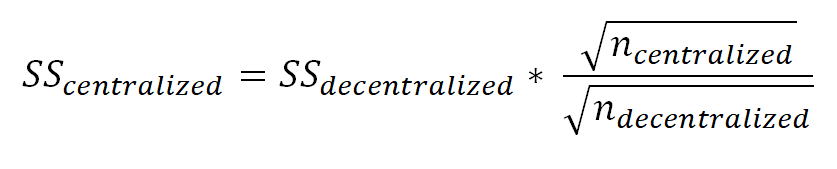
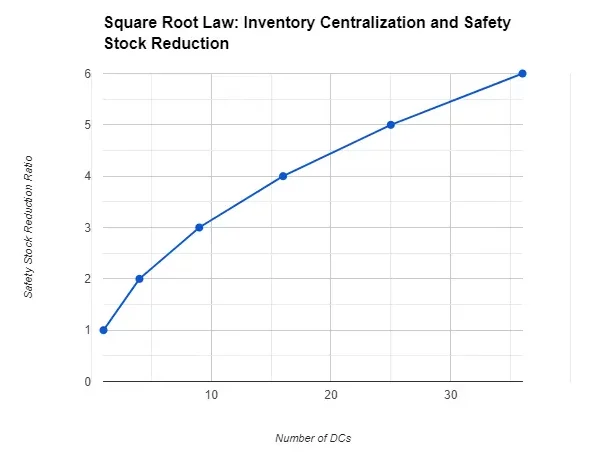
Suppose you have 4 decentralized warehouses, each holding safety stock of 100 units. If you centralize this inventory into one location, the new safety stock would be:

This shows a 50% reduction in safety stock due to centralization.
Reduction in Safety Stock:Centralizing inventory leads to a significant reduction in safety stock. This decreases the overall inventory holding costs, freeing up capital and reducing the risk of obsolescence.
Impact on warehousing costs: Centralization reduces the number of warehouses, leading to savings on fixed costs like rent and labor. However the remaining warehouses may need to be larger or more advanced, which could increase costs at these locations. The net impact on warehousing costs depends on the balance between reduced locations and potentially higher costs at central sites.
Increased Lead Times and Service Level Impacts: While centralizing inventory can reduce safety stock, it may also increase lead times to customers. With inventory located further from end customers, the time to fulfill orders might increase, potentially impacting service levels. Companies need to balance the benefits of lower safety stock against the potential cost of slower response times.
Increased Transportation Costs: When inventory is centralized, products often need to be shipped over longer distances to reach customers. This can lead to higher transportation costs, as goods must be moved from a single, central location to various points of demand.
The increased transportation costs might offset some of the savings achieved through reduced safety stock. Additionally, transportation costs can fluctuate with fuel prices and other factors, introducing variability in total logistics costs. Therefore, it’s essential to analyze whether the savings in inventory costs outweigh the potential rise in transportation expenses.
Balancing these factors requires a comprehensive analysis to determine the optimal number and location of warehouses in a supply chain network. Companies might find that a hybrid approach—centralizing certain types of inventory while keeping others decentralized—offers the best trade-off between cost and service.
Centralizing inventory can create significant opportunities to reduce safety stock and working capital. But closing warehouses or moving inventory without analyzing the entire network can create unexpected transportation and service-level costs.
Lambda Supply Chain helps companies model and optimize their supply chain networks before making major infrastructure and inventory decisions.
With supply chain network design and optimization, teams can evaluate different warehouse configurations, model inventory and transportation trade-offs, run what-if scenarios, and identify the network that best balances cost and service.
Contact us today to learn more about how our Services can drive success for your business.
We’re excited to discuss what problems you are facing and how can you make your existing supply chain more efficient by continuously designing it.