
Lambda Supply Chain Listed as a Representative Vendor in Gartner® Market Guide for Supply Chain Network Design Tools
Updated Oct 2026
Subscribe to receive latest resources on supply chain design
Modern supply chains require more than operational planning. Organizations need software that enables them to design new networks, optimize existing ones, simulate real-world scenarios, and evaluate strategic changes before implementation. This ability to model and test decisions has become essential for building resilient, cost-efficient, and future-ready supply chains.
Whether you’re redesigning a distribution network, optimizing transportation flows, improving inventory positioning, or preparing for future disruptions, the best supply chain design software helps you make faster, smarter, and more confident decisions before investing in change.
We evaluated leading supply chain design software based on optimization capabilities, AI features, simulation, ease of implementation, cloud architecture, scalability, integration options, and overall suitability for different business needs. Rather than ranking platforms based on popularity alone, this guide focuses on the capabilities that matter most for strategic supply chain decision-making and helps organizations compare solutions objectively.
Today’s supply chain software goes far beyond planning and execution. Modern platforms empower organizations to:
The objective is no longer just to automate operations, it’s to make better strategic decisions before they impact the business.
Not every platform solves the same business problems. The best solutions combine multiple capabilities into one integrated environment.
Helps determine the optimal structure of your supply chain by evaluating warehouse locations, transportation flows, production allocation, sourcing strategies, and customer assignments.
Questions it answers:
Simulation validates how a proposed network performs under changing business conditions.
It allows organizations to evaluate:
Instead of asking “What’s the best design?”, simulation asks:
“How will this design perform in the real world?”
The newest generation of platforms combines AI with optimization and simulation to help users:
A modern platform should connect seamlessly with enterprise systems and cloud data platforms such as:

Without reliable data integration, even the best optimization engine cannot produce reliable recommendations.
Decision-makers shouldn’t have to interpret spreadsheets.
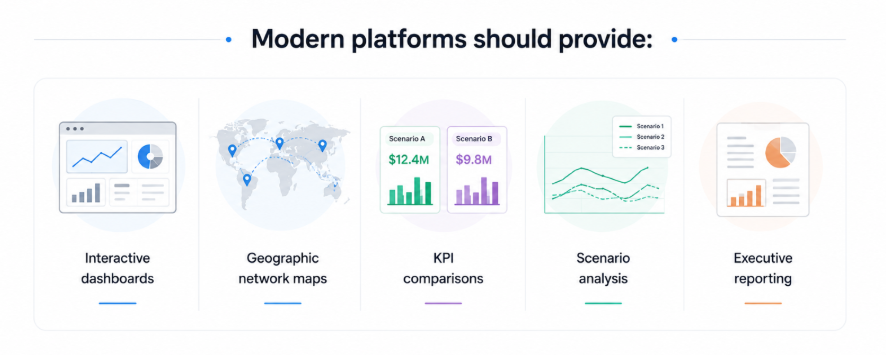
Rather than focusing only on vendor names, evaluate the capabilities that will have the biggest impact on your business.
Capability | Why It Matters |
Network Optimization | Design cost-efficient supply chain networks |
Scenario Planning | Compare multiple business strategies |
Supply Chain Simulation | Validate decisions before implementation |
AI Assistance | Accelerate analysis and improve productivity |
Data Integration | Connect enterprise data sources seamlessly |
Cloud Scalability | Handle enterprise-scale optimization models |
Visualization | Communicate insights across teams |
Collaboration | Enable cross-functional decision making |
Several supply chain design tools offer strong capabilities depending on your organization’s requirements.
Platform | Best For | Strengths |
★ Lambda Supply Chain (Lambda Lab) | Organizations of any size looking for an affordable, all-in-one decision intelligence platform | Network Optimization, Simulation, AI-Powered Insights, SKU-Level Analysis, Cloud-Native & Easy to Deploy, No Learning Curve |
Optilogic | Large enterprises needing complex network design at scale | Optimization, digital twin simulation, AI-assisted model building |
Coupa Supply Chain Design | Organizations already using Coupa for procurement/spend management | Network design & sourcing tightly integrated with Coupa’s BSM suite |
Sophus X | Budget-conscious teams wanting fast network design projects | AI-assisted modeling, drag-and-drop UI; limited risk scoring |
AIMMS | Technical analysts who want granular, code-based control | Low-code/SQL-based mathematical optimization; no built-in simulation |
AnyLogic | Teams needing deep, custom simulation modeling | Discrete-event & agent-based simulation for logistics systems |
Blue Yonder | Large enterprises needing an integrated demand-to-fulfillment suite | Broad SCM planning suite with AI/ML-driven demand sensing |
Kinaxis | Large global enterprises (1,000+ employees) needing real-time concurrent planning | Real-time scenario simulation and orchestration; steep learning curve |
Note: The platforms above are included for general market awareness. The right choice depends on your organization’s objectives, data maturity, scalability requirements, and planning processes rather than a universal ranking.
Instead of asking,
“Which software is the best?”
Ask,
“Which software is best for our business?”
If your priority is…
Business Goal | Look For |
Reduce logistics costs | Network Optimization |
Improve inventory decisions | Inventory Optimization |
Evaluate disruptions | Simulation |
Design future networks | Scenario Planning |
Improve decision speed | AI Decision Intelligence |
Connect enterprise systems | Strong Integration Framework |
Questions Every Buyer Should Ask
Before investing in any supply chain design platform, ask these questions:
✓ Can it optimize complex supply chain networks?
✓ Does it support simulation and scenario analysis?
✓ Can business users create models without heavy coding?
✓ Does it integrate with our existing systems?
✓ Can it scale with our business?
✓ Does it include AI capabilities?
✓ Can it compare multiple scenarios side by side?
Traditional planning software tells you what happened.
Modern decision intelligence platforms help you understand:
By combining optimization, simulation, AI, and integrated data, organizations can evaluate strategic decisions before investing time and resources.
This shift enables supply chain teams to move from reactive planning to proactive decision making.
Lambda’s supply chain network design software is built to remove the two biggest barriers to supply chain modelling: cost and complexity.
One platform, every strategic and tactical decision:
Lambda Supply Chain turns weeks of manual modeling into hours so your team can spend less time building spreadsheets and more time making decisions.
.