
Lambda Supply Chain Listed as a Representative Vendor in Gartner® Market Guide for Supply Chain Network Design Tools
Published Nov 2026
Subscribe to receive latest resources on supply chain design
Compare leading supply chain planning platforms, their capabilities, and the factors to consider when choosing the right solution for your business.
Choosing supply chain planning software is not simply about finding a platform with the most features. It is about finding a solution that addresses your business’s planning challenges.
Some businesses need to improve demand forecasting and inventory management. Others need to coordinate planning across global suppliers, manufacturing facilities, and distribution networks. Manufacturers facing capacity constraints may have a different priority: turning material requirements into feasible production and supply plans.
Although many platforms cover overlapping capabilities, they differ in planning scope, constraint handling, scenario analysis, integration options, and implementation requirements.
In this guide, we compare eight supply chain planning platforms based on their publicly documented capabilities and the planning requirements businesses should evaluate. Lambda Supply Chain, the publisher of this guide, is one of the eight; its entry draws on the same kind of published product information as the others.
The objective is not to identify one universal winner, but to help you shortlist the software that best fits your supply chain.
The short answer
There is no single best platform. Broad enterprise suites suit organizations that want demand, supply, inventory, and S&OP planning in one environment. A more focused tool may fit better when the main problem is plans that ignore material or capacity limits. Use the comparison in section 3 and the decision guide in section 4 to shortlist, then test each option on your own data.
Before comparing products, define the planning problems you need to solve. A platform that works well for demand forecasting may not be the right choice for complex, capacity-constrained supply planning.
Here are six important evaluation criteria.
Planning capabilities: Does the software support the functions you need, such as demand planning, inventory planning, supply planning, production scheduling, or sales and operations planning (S&OP)?
Constraint handling: Can it evaluate plans against material availability, supplier lead times, production capacity, qualified production lines, and warehouse limits?
Scenario analysis: Can planners compare alternatives when demand changes, suppliers are delayed, or production capacity becomes unavailable?
Data integration: How does the platform connect with your ERP, databases, and other planning systems? Consider the effort required to prepare and maintain the data.
Plan visibility and explainability: Can users understand why a plan changed, which constraints affect it, and what exceptions remain?
Implementation and total cost: Evaluate implementation effort, training, support, ongoing maintenance, and the cost of the capabilities you actually need.
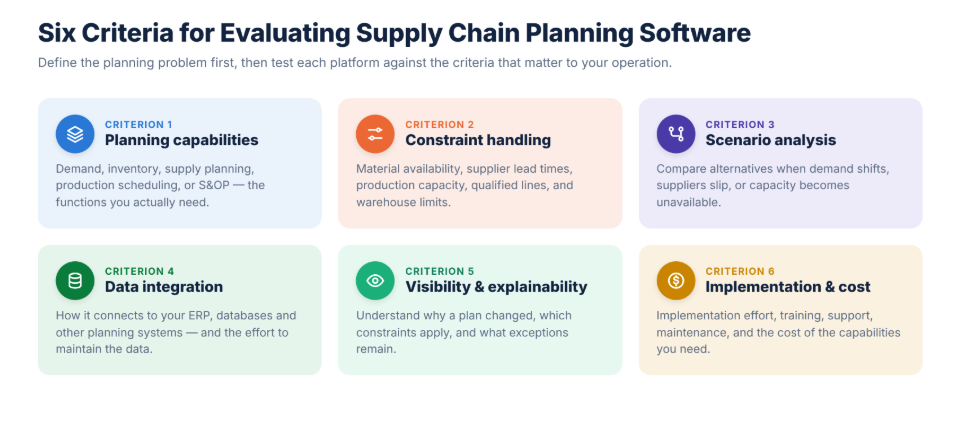
These criteria provide a useful framework for evaluating the platforms below.
Supply chain planning platforms offer different combinations of planning capabilities, from demand forecasting and inventory planning to constrained supply planning and production scheduling.
The following comparison summarizes capabilities described on each vendor’s official product website. Platforms are listed alphabetically, not ranked. The list is not exhaustive, and other vendors may suit your requirements better. This is a comparison of published product information, not an independent assessment of software performance.
Planning Software | Capabilities described by the vendor | Best suited for |
Lambda Supply Chain (Lambda Lab) | MRP with a constraint layer across suppliers, plants, and warehouses; automatic plan smoothing; scenario comparison; explanations of plan exceptions; integrations with ERP systems and data platforms. | Producing feasible supply plans within material and capacity limits, alongside an existing ERP |
Anaplan Supply Planning | Production, capacity, and material requirements planning; scenario modeling and analysis. | Planning production, capacity, and material requirements with scenario modeling |
Blue Yonder Supply Chain Planning | Integrated business planning, demand and supply planning, production planning and scheduling, and inventory-related capabilities. | Integrated demand, supply, and production planning, including scheduling |
Kinaxis Maestro | Supply chain orchestration, concurrent planning, data integration, simulation- and optimization-based decisioning, and AI-enabled decision support. | Coordinating plans and decisions across the enterprise |
Logility (an Aptean company) | Demand planning, inventory optimization, supply planning, scenario planning, and supply chain design. | Combining demand, inventory, and supply planning with network design |
o9 Digital Brain | Supply planning, unified data modeling, optimization methods, and planning across different business horizons. | Planning across horizons on one data model with optimization methods |
Oracle Fusion Cloud Supply Chain Planning | Demand management, supply planning, inventory planning, production scheduling, sales and operations planning, and scenario analysis. | Demand, supply, inventory, production, and S&OP planning in one cloud suite |
SAP Integrated Business Planning (SAP IBP) | Forecasting and demand management, response and supply planning, inventory planning, sales and operations planning, and scenario analysis. | Forecasting, supply, inventory, and S&OP planning in one integrated suite |
Note: This comparison summarizes capabilities described in vendor-published product information reviewed on October 29, 2026. The “Best suited for” column is our summary of those capabilities, not a vendor statement. Specific features, availability, and functionality may vary by product module, configuration, or subscription. Readers should consult the linked official pages and confirm requirements directly with vendors.
The capabilities listed above are not a substitute for a detailed product evaluation. Before selecting a platform, businesses should verify which functions are included in the proposed solution, how those functions handle their planning constraints, and whether the product supports their required workflows and data environment.
The next step is to compare shortlisted platforms against representative business scenarios, implementation requirements, and total cost of ownership.
The right shortlist depends on the problem you are trying to solve.
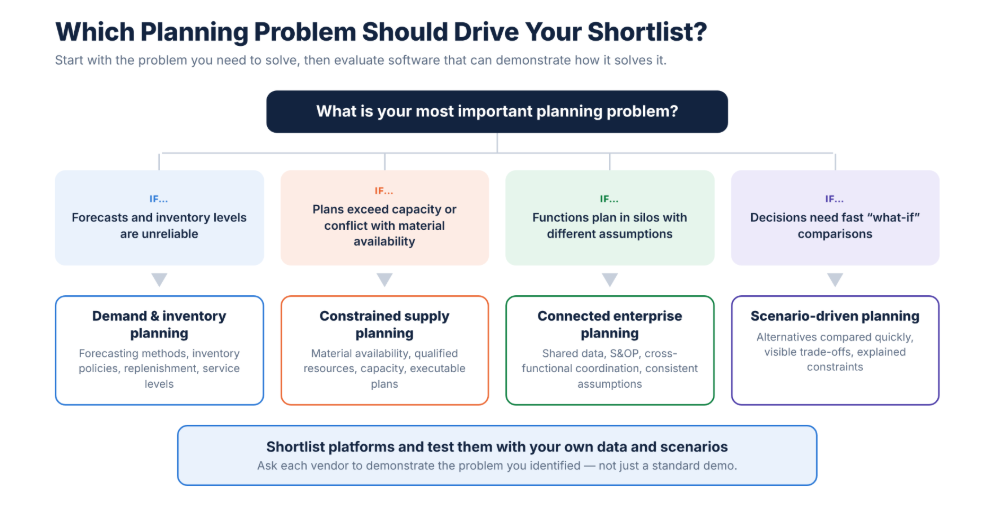
Your primary requirement | What to prioritize |
Enterprise-wide planning | Demand, supply, inventory, and S&OP capabilities with cross-functional coordination |
Manufacturing and capacity-constrained planning | Material availability, qualified production resources, capacity, and executable supply plans |
Demand and inventory planning | Forecasting methods, inventory policies, replenishment, and service-level requirements |
Connected planning across functions | Shared data, scenario analysis, coordinated decisions, and consistent planning assumptions |
Scenario-driven decisions | Fast comparison of alternatives, visibility into trade-offs, and explanations of constraints |
A broad enterprise platform may be appropriate when you need several planning disciplines within one environment. A more focused solution may deserve consideration when a particular planning problem is the priority.
If demand forecasting is your main challenge, evaluate forecasting methods and their performance. If production plans routinely exceed available capacity or conflict with material availability, look more closely at constrained supply planning and automatic plan smoothing.
Start with the planning problem, then shortlist software that can demonstrate how it solves that problem.
Supply chain planning software costs vary by product, deployment, modules, number of users, data complexity, and implementation requirements.
Enterprise vendors typically price through custom quotations, commonly based on factors such as the modules selected, the number of users, and the scope of the deployment (for example, sites or SKUs), with implementation and integration services often quoted separately. Published prices may therefore not be available or directly comparable.
The software subscription or license is only one part of the investment. Businesses should also consider:
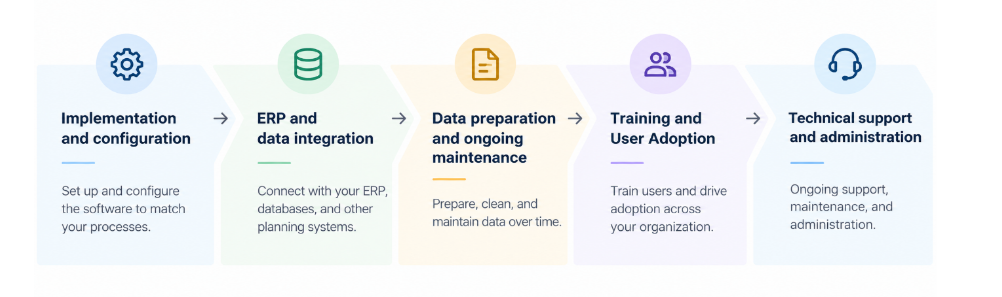
Instead of comparing price alone, estimate the total cost of ownership and assess it against the planning problems the solution is expected to address.
During vendor discussions, ask for a clear breakdown of licensing, implementation, integration, and ongoing support costs. Also confirm which capabilities are included in the proposed package, and which require additional applications or services.
Even a capable platform can be a poor fit if the selection process does not reflect the business’s actual requirements.
Choosing based on features alone. A long feature list does not prove that the software can solve your most important planning problem. Test the capabilities that matter to your operation.
Assuming all planning products do the same thing. Demand forecasting, inventory optimization, supply planning, and production scheduling are distinct capabilities. Verify which are included and how they work together.
Underestimating data quality and integration. Planning depends on reliable demand data, bills of materials, inventory, supplier information, production capabilities, and lead times.
Overlooking operational constraints. If your business faces capacity limits, shortages, or qualified-resource restrictions, make sure the platform evaluates these constraints rather than requiring extensive manual correction afterward.
Skipping realistic scenario testing. Do not rely only on a standard product demonstration. Test the software using representative data and scenarios from your own operation.
A good evaluation should establish not only whether the software can generate a plan, but whether that plan can work within your business’s real constraints.
Lambda Supply Chain Planning is the supply planning module of Lambda Lab, Lambda’s platform for supply chain planning and design. It is worth evaluating when the gap between calculated requirements and operational feasibility is a major problem.
Its focus is not to claim that every planning need belongs in a single application. Instead, it addresses a specific requirement: generating supply plans that account for actual material and capacity constraints.
Users load SKU-level demand data and relevant constraints, create a scenario, and run the model. The software then performs the MRP calculations, constraint checking, and plan smoothing needed to develop a feasible supply plan.
This helps planners assess whether demand can be met with available resources, understand remaining exceptions, and evaluate alternative assumptions before committing to a plan.
Against the evaluation criteria in section 2:
Lambda Lab includes Network Design and Route Design, which address complementary questions related to supply chain structure and transportation routes. It also offers Production Scheduling and Demand Forecasting as part of its comprehensive suite of solutions.
For businesses considering a focused approach to constrained supply planning, Lambda provides an additional option to evaluate alongside broader enterprise planning platforms.
Explore the capabilities on the Lambda Supply Chain Planning product page, and ask us to run a scenario on your own data.
The best supply chain planning software is not necessarily the platform with the most features. It is the solution that addresses your business’s most important planning challenges, works with your data and systems, and supports the decisions your teams need to make.
For some organizations, that means an integrated enterprise planning suite. For others, it may mean strengthening demand and inventory planning or addressing capacity-constrained supply planning.
Define your requirements, evaluate vendors against realistic scenarios, and check that the resulting plans can support your operating needs.
Choose software based on the planning problem you need to solve not simply the number of features it offers.