
Lambda Supply Chain Listed as a Representative Vendor in Gartner® Market Guide for Supply Chain Network Design Tools
Published Oct 2026
Subscribe to receive latest resources on supply chain design
Turn demand plans into feasible supply plans by accounting for real-world capacity, material availability, and operational constraints.
A supply chain plan can look good on paper and still be impossible to execute.
A forecast may indicate how much product customers will need, and Material Requirements Planning (MRP) may calculate how much to buy or produce. But what happens when a production line lacks capacity, a supplier cannot deliver materials on time, or a warehouse reaches its storage limit?
These constraints can turn a seemingly workable plan into a series of manual adjustments. Planners may spend hours fixing overloaded production schedules, moving orders between weeks, managing material shortages, and updating spreadsheets to make the plan executable.
The challenge is not simply calculating what the business needs. It is determining what the supply chain can realistically deliver with the resources available.
This is why Lambda Lab (Lambda Supply Chain) is expanding its suite of supply chain solutions with Supply Chain Planning software. The solution retains familiar MRP logic while adding a constraint layer that evaluates requirements against real operating limits, helping businesses turn demand into feasible supply plans by accounting for production capacity, material availability, and other operational constraints before plans reach suppliers, plants, and warehouses.
Lambda Supply Chain Planning helps businesses transform demand requirements into a feasible supply plan across suppliers, plants, and warehouses.
Instead of calculating requirements in isolation and leaving planners to resolve capacity overloads and material shortages afterward, the solution evaluates the plan against the constraints that affect execution.
It accounts for factors such as production capacity, qualified plant and line capabilities, raw-material availability, warehouse limits, lead times, working calendars, and inventory policies.
When the initial plan exceeds these limits, the system can evaluate adjustments such as building inventory earlier, using alternative production lines, timing production around material arrivals, or rebalancing stock.
The aim is to produce a plan that reflects operational realities before it is released for execution.
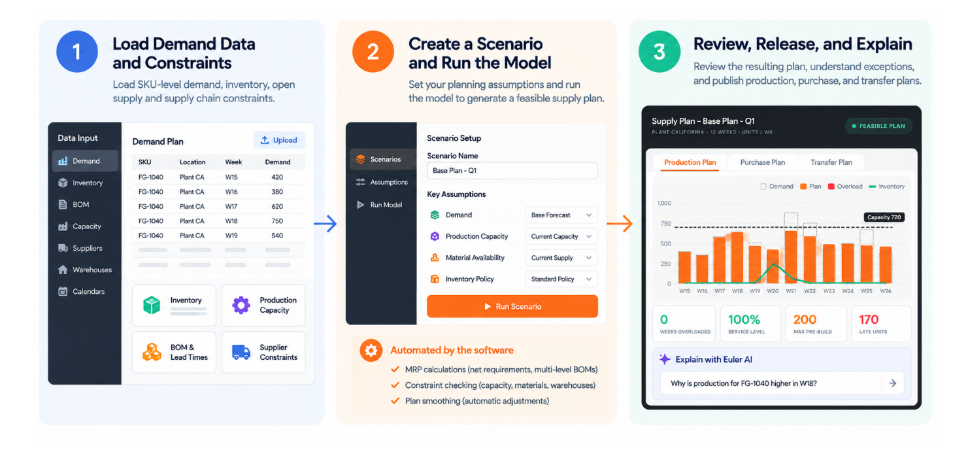
Lambda Supply Chain Planning keeps the planning workflow simple. Users load the required data, create a scenario, and run the model. The system handles the underlying planning calculations automatically.
1. Load Demand Plan and Constraints
Load SKU-level demand data, including forecast and firm orders, along with relevant inventory, open supply, and supply chain constraints. These inputs establish the requirements and operating limits the model needs to generate a feasible supply plan.
2.Create a Scenario and Run the Model
Define a scenario based on the planning assumptions you want to evaluate, then run the model to generate a supply plan.
During execution, the software automatically handles the underlying planning calculations, including:
3. Release and Explain
Review the resulting plan and its exceptions, then publish production, purchase, and transfer plans. The software provides explanations and traceability into the requirements and constraints behind the plan.
By evaluating constraints and smoothing the plan before release, Lambda Supply Chain Planning helps planners identify potential issues earlier and understand the adjustments needed to create a feasible plan.
Supply chain constraints rarely exist in isolation. A material shortage can delay production, a capacity limitation can shift output into another week, and additional production can put pressure on warehouse space.
A feasible supply plan therefore needs to consider these relationships across the network.
Lambda Supply Chain Planning models six key areas:
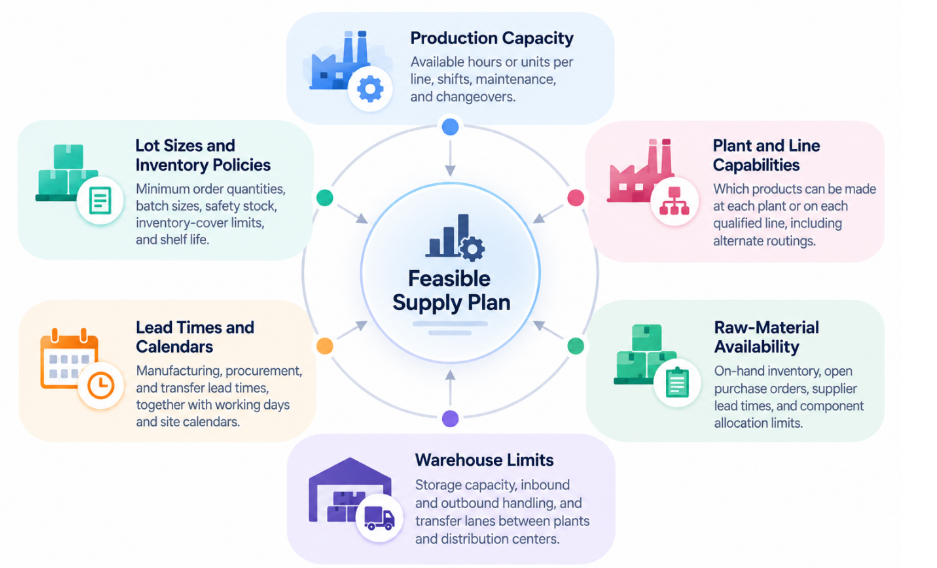
Considering these constraints together helps planners understand not only what needs to happen, but also where the plan may become infeasible and what adjustments could address the problem.
Supply chain conditions change. Demand can rise unexpectedly, suppliers can deliver late, and plants can lose capacity because of maintenance or other disruptions.
Instead of manually rebuilding a plan for every possibility, planners can create a separate scenario, change selected assumptions, and rerun the constrained plan. Lambda allows teams to compare scenarios across service, cost, inventory, and capacity utilization before promoting the preferred plan.
For example, a planning team could test:
Scenario | What the team needs to evaluate |
Demand increases by 20% | Can supply and capacity support the additional demand? |
A production line is unavailable for three weeks | Can production be moved to another line or earlier period? |
A raw-material supplier is delayed | How should production timing and material requirements change? |
An additional Saturday shift is introduced | Does the extra capacity improve feasibility enough to justify the change? |
These scenarios help planners assess alternatives before committing to changes in production, purchasing, or inventory.
A key benefit is that each scenario can be evaluated separately from the live plan. Teams can compare the results and promote the preferred scenario when they are ready.
Supply planning depends on accurate and consistent data. Demand, bills of materials, production routings, inventory, and purchase orders all influence the resulting plan.
Lambda Supply Chain Planning connects with ERP systems and data platforms, including SAP, Oracle, Microsoft Dynamics, SQL Server, and Snowflake, alongside Databricks and Excel/CSV inputs. This allows planning to use the business data needed to calculate requirements and evaluate constraints.
The solution also includes Euler AI, which allows planners to ask questions about a plan in plain language and understand why particular changes were made.
For example, a planner might ask:
“Why did production for this product move into an earlier week?”
Rather than simply showing a revised date, the system can explain the underlying constraint and the adjustment made. If a later week has demand above available line capacity, for example, the explanation can show how pre-building inventory in earlier weeks helps keep orders on time while respecting inventory-cover limits.
This visibility matters because a feasible plan needs to be understandable as well as executable. Planners need to know where exceptions remain, which constraints are binding, and why the recommended adjustments make sense.
Supply Chain Planning expands Lambda Lab’s portfolio alongside its existing Network Design and Route Design capabilities.
Each solution addresses a different part of supply chain decision-making.
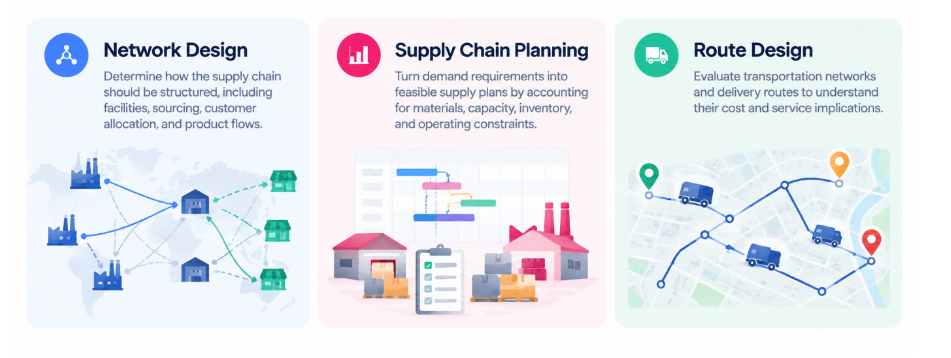
These capabilities address complementary questions. Network Design focuses on the structure of the supply chain, while Supply Chain Planning determines how requirements can be met within the available operating resources. Route Design focuses on the transportation network.
Planning can also reveal when the existing network itself needs attention. Persistent capacity shortages, for example, may indicate that better scheduling alone will not be enough and that the business should evaluate a structural network change.
Creating a supply chain plan involves more than calculating demand and generating purchase or production requirements. The plan must also account for capacity, material availability, lead times, warehouse limits, and the operating rules that determine what can actually happen.
Lambda’s Supply Chain Planning Software addresses this challenge by combining MRP with constraint evaluation, plan smoothing, scenario analysis, and explainable results.
By adding Supply Chain Planning to Lambda Lab, Lambda Supply Chain helps businesses move beyond designing their supply chain network to planning how demand can be met within real-world constraints such as material availability and production capacity.
Don’t stop at what needs to happen. Build a plan that can actually happen.