
Lambda Supply Chain Listed as a Representative Vendor in Gartner® Market Guide for Supply Chain Network Design Tools
Published June 2026
Subscribe to receive latest resources on supply chain design
Every delivery operation starts with a route.
The real question is whether that route is simply planned or truly optimized.
As transportation networks become larger and more complex, logistics teams face increasing pressure to reduce costs, improve service levels, and maximize fleet productivity. In this environment, route planning and route optimization are often used interchangeably. While closely connected, they serve different purposes and are both essential for building efficient, scalable logistics operations.
The organizations that consistently reduce costs and improve service performance combine route planning with route optimization.
At Lambda Supply Chain Solutions, we help companies move beyond static route creation by combining planning intelligence with advanced Supply chain route design and optimization capabilities that identify the most efficient delivery strategies across complex networks.
Supply chain route planning is the process of defining delivery requirements and operational constraints before routes are created.
At this stage, businesses determine:
In simple terms, route planning defines the problem that needs to be solved.
For example, a beverage distributor serving 500 retail stores may know exactly which stores require deliveries next week, how much product each store needs, and which distribution centre will fulfil those orders.
This information is critical, but it does not determine the most efficient way to execute deliveries.
Planning defines the problem. It does not solve it.
As delivery networks grow, route complexity increases dramatically.
Planners often face questions such as:
For large distribution networks, there may be thousands or even millions of possible routing combinations. Evaluating every option manually is impractical, which often results in routes that are operationally feasible but far from optimal.
This is where route optimization becomes critical.
Supply Chain route optimization uses advanced algorithms to evaluate thousands of routing scenarios and identify the best possible route structure based on operational objectives and constraints.
Instead of relying solely on manual decision-making, optimization engines determine:
At Lambda, route optimization is not simply about sequencing stops.
Our supply chain route design platform evaluates multiple dimensions of network performance simultaneously, helping organizations build routes that align with business goals while respecting real-world operating constraints.
Once customer demand, warehouse assignments, fleet information, and service requirements are loaded into the platform, Lambda can generate and evaluate thousands of routing scenarios in minutes.
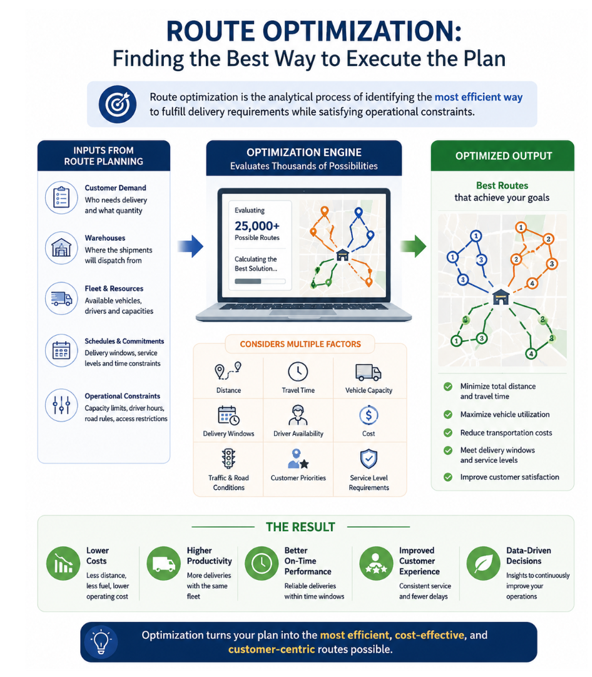
Supply Chain Route planning and route optimization are not competing approaches—they are complementary capabilities.
Without route planning, organizations lack the information needed to build delivery strategies.
Without route optimization, organizations risk executing routes that are unnecessarily expensive, inefficient, and difficult to scale.
A modern routing workflow looks like this:
Customer Data + Demand Data + Warehouse Data + Fleet Data
↓
Delivery Planning
↓
Route Optimization & Scenario Analysis
↓
Optimized Route Assignments and Stop Sequences
↓
Execution-Ready Routes
By combining planning inputs with optimization technology, businesses can create delivery networks that are both practical and efficient.
Organizations that adopt advanced route design and optimization capabilities often achieve measurable improvements across their transportation operations.
Lower Transportation Costs
By reducing unnecessary mileage and drive time, organizations can significantly decrease fuel consumption and operating expenses.
Improved Fleet Productivity
Better route design enables vehicles to serve more customers while maximizing available capacity.
Enhanced Customer Service
Optimized routes improve schedule reliability and support stronger on-time delivery performance.
Faster Planning Cycles
Transportation teams can evaluate network changes and generate new routing plans in a fraction of the time required by manual methods.
Greater Scalability
As customer demand grows, optimized routing allows organizations to manage increasing complexity without proportionally increasing planning resources.
At Lambda Supply Chain Solutions, we believe route optimization should not be viewed as a standalone activity.
The greatest value comes from treating route design as part of a broader supply chain network optimization strategy.
By combining demand data, customer requirements, operational constraints, and advanced optimization technology, organizations can design transportation networks that are more efficient, more scalable, and more resilient to change.
Route planning answers the question:
What needs to be delivered?
Route optimization answers the question:
What is the best way to deliver it?
The most successful logistics organizations use both.
They define the right requirements, then leverage optimization to identify the most efficient way to execute them.
That is how modern transportation networks reduce costs, improve service levels, and create sustainable competitive advantage.