
Lambda Supply Chain Listed as a Representative Vendor in Gartner® Market Guide for Supply Chain Network Design Tools
Published April 2026
Subscribe to receive latest resources on supply chain design
Global supply chains are being reshaped in real time. Rising tensions in the Middle East, fluctuating oil prices, and shifting shipping routes are forcing organizations to rethink how they plan and operate.
The difference between disruption and resilience is no longer only the speed of reaction-it is also the ability to simulate decisions before they are needed.
While disruptions are increasing, they also present an opportunity. Companies that leverage advanced scenario modeling can anticipate changes, control costs, and maintain service continuity. Instead of reacting to uncertainty, supply chain leaders are using what-if simulations to test alternatives and stay ahead of volatility.
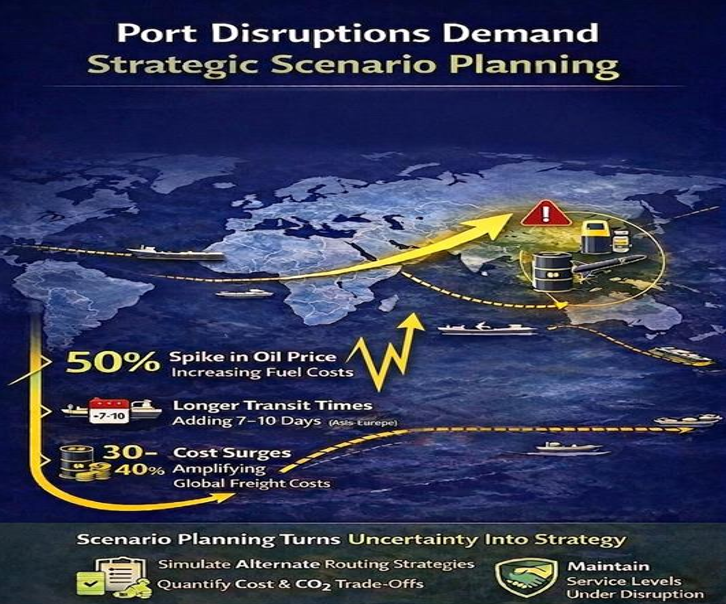
Ongoing geopolitical tensions in the Middle East—including risks around the Strait of Hormuz, a critical global oil chokepoint—demonstrate how quickly supply conditions can tighten. During periods of heightened risk, oil markets have reacted sharply, with short-term price surges reaching 40–50% in extreme cases, significantly amplifying transportation costs across global supply chains.
Rerouted shipping lanes are adding 7–10 days to Asia–Europe transit times, directly affecting inventory availability and production schedules. These disruptions are cascading across procurement, manufacturing, and distribution—raising transportation costs and extending lead times.
Organizations are already experiencing:
Modern network modeling platforms such as Lambda Lab allow organizations to simulate alternate routing strategies, evaluate fuel cost scenarios, and identify cost-effective ways to maintain service continuity under disruption.
Supply chains must shift from reactive firefighting to proactive resilience.
Scenario planning allows organizations to quantify trade-offs before disruptions occur—turning uncertainty into a controlled decision space. Instead of reacting after constraints hit, teams can evaluate multiple disruption combinations in advance.
Companies can simulate:
For example, rerouting a portion of volume through an alternate port while shifting high-priority SKUs to air freight may increase short-term costs by 3–5x, but it can prevent stockouts, protect revenue, and maintain customer service levels.
This approach enables organizations to reduce risk while maintaining performance—rather than choosing between cost and service.
When ports face congestion or closure, companies must evaluate alternative entry points quickly. However, these alternatives often come with trade-offs.
Switching to secondary ports can increase inland transportation costs by approximately 10–15%, depending on distance and infrastructure, while also extending last-mile transit times.
Network simulation allows organizations to test these alternatives virtually—before committing operational changes.
Key actions include:
By evaluating these scenarios in advance, companies can avoid costly trial-and-error decisions and maintain both cost control and service reliability
Oil price fluctuations continue to impact transportation across ocean, trucking, and air freight.
A $10 per barrel increase in crude oil can raise transportation costs by approximately 2–4%, depending on mode and network structure. Without proactive planning, these shifts can quickly erode margins.
To remain cost-efficient, organizations must continuously evaluate:
Scenario-based planning helps companies adapt these levers dynamically ensuring cost efficiency without compromising service levels.
Geopolitical uncertainty and energy volatility are no longer temporary—they are structural.
Organizations that adopt scenario-driven planning gain a significant advantage:
With digital twin–based modeling platforms like OptiFlow, companies can move beyond reactive responses and build supply chains that are inherently more resilient, cost-efficient, and adaptable.
Supply chain disruptions are no longer exceptions-they are part of the operating environment.
The companies that outperform in volatile conditions are not the ones that react fastest-they are the ones that have already simulated their next move.
By embedding scenario-driven planning into supply chain design, organizations can anticipate disruptions, control costs, and maintain service performance-even under uncertainty.