
Transform Your Supply Chain Today.
Join leading brands using Lambda to build cost-effective, resilient and sustainable supply chains.
Lambda Supply Chain Listed as a Representative Vendor in Gartner® Market Guide for Supply Chain Network Design Tools
Published Aug 2026
Subscribe to receive latest resources on supply chain design
It’s the beginning of your busiest sales season.
Orders are climbing every hour, warehouses are operating at full capacity, and trucks are leaving distribution centers around the clock.
Then, the call comes.
Your largest distribution center has caught fire.
Operations stop immediately.
The facility was responsible for fulfilling nearly 40% of customer demand. Millions of dollars’ worth of inventory is suddenly inaccessible, and thousands of customer orders are scheduled to ship over the next few days.
Within minutes, the leadership team gathers to answer questions that can’t wait.
Every decision affects inventory, transportation, warehousing, customer service, and ultimately revenue.
Making the wrong decision could cost millions.
Making no decision could cost even more.
This isn’t just a logistics problem.
It’s a Supply Chain Network Design problem.
Supply Chain Design is the strategic process of planning how products, information, and resources move from suppliers to customers. It establishes the foundation of a supply chain by determining the most efficient way to source, manufacture, store, transport, and deliver products while balancing cost, service, resilience, and growth.
Unlike day-to-day operations, which focus on execution, Supply Chain Design focuses on long-term strategic decisions that shape the entire supply chain. A well-designed supply chain helps businesses reduce costs, improve customer service, respond to disruptions, and support future expansion.
At the heart of Supply Chain Design lies Supply Chain Network Design the discipline that determines how products flow efficiently through the supply chain.
Supply Chain Network Design focuses specifically on the physical structure of the supply chain determining where facilities should be located, how inventory should be positioned, and how products should flow between suppliers, warehouses, and customers to achieve the best business outcomes.
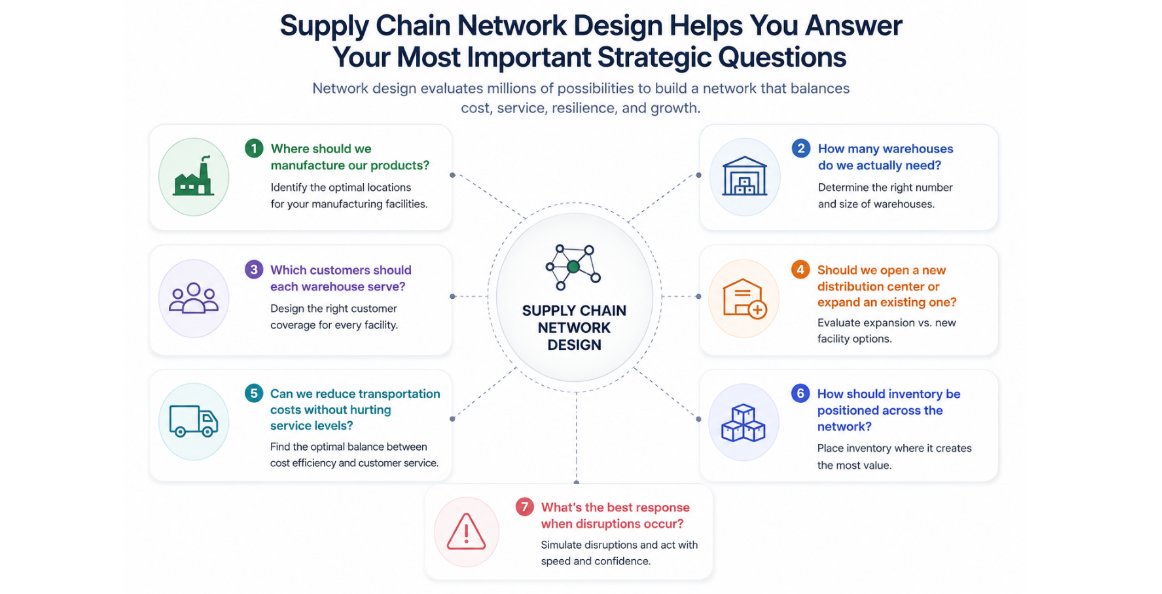
In other words, Network Design helps businesses evaluate thousands of possible options before committing to one.
While unexpected events like warehouse fires highlight its importance, network design delivers value every day.
Businesses constantly face strategic decisions that shape their future.
Imagine your company is planning to expand into South America.
Should you continue serving the region from your existing warehouses, or is it time to establish a new distribution center closer to customers?
Perhaps transportation costs have risen by 18%.
Would relocating inventory reduce freight costs enough to justify the additional warehouse expense?
Or maybe customer expectations have shifted, and next-day delivery has become the new standard.
Can your current network support that promise without significantly increasing operational costs?
Other common questions include:
These aren’t operational decisions.
They’re strategic decisions that shape the future performance of the business.
Supply Chain Design isn’t one decision. It’s a set of interconnected decisions that together shape how a business operates.
It typically includes:
Each of these decisions affects the others. A sourcing change shifts transportation costs. A new distribution center changes inventory strategy. That’s why Supply Chain Design treats them as one connected system, not six separate projects.
No two networks are designed the same way, because no two businesses face the same constraints. The factors that typically shape a network include:
Getting network design right means weighing all these factors together, not optimizing for one and hoping the rest fall into place.
Designing, or redesigning, a network follows a consistent process, whether it’s done manually or with modern tools
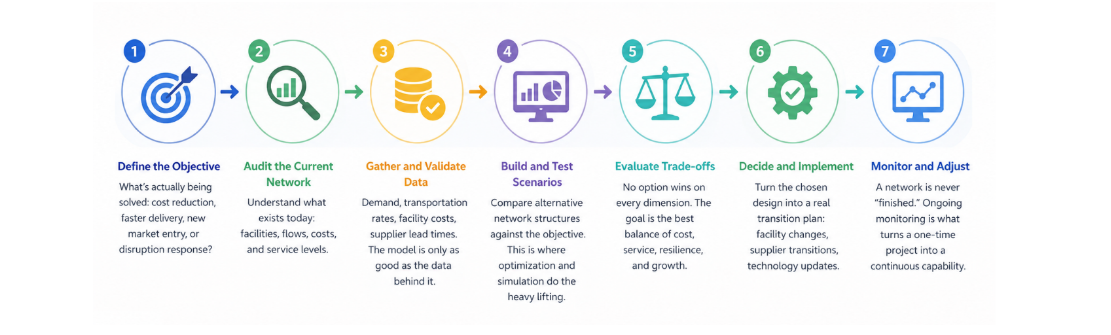
The steps don’t change. What’s changed is how fast each step can happen. A process that once took months of manual modeling can now run in a fraction of the time with the right tools.
Let’s return to the retailer from the beginning of this article.
It’s peak season, and the company’s largest distribution center has unexpectedly shut down after a fire. Nearly 40% of its inventory is inaccessible, thousands of customer orders are waiting to be fulfilled, and every hour of delay increases costs and impacts customer satisfaction.
The leadership team now faces several possible options.
At first glance, every option seems reasonable.
However, each decision affects transportation costs, inventory availability, warehouse capacity, delivery times, and customer service. Optimizing one area may negatively impact another.
This is where Supply Chain Network Design provides the answer.
Instead of relying on assumptions or intuition, planners can model each scenario, compare the trade-offs, and evaluate the impact before making changes in the real world.
For example, the analysis may reveal that:
Option | Transportation Cost | Service Level | Implementation |
Ship only from the remaining warehouses | Low implementation effort | Longer delivery times | Immediate |
Lease a temporary 3PL warehouse | Moderate cost increase | High service levels | Short-term solution |
Reposition inventory across the network | Balanced transportation cost | High service levels | Recommended |
Combine inventory repositioning with a temporary warehouse | Slightly higher operating cost | Highest resilience and customer service | Best long-term outcome |
Rather than selecting the cheapest option, Supply Chain Network Design identifies the solution that delivers the best overall balance between cost, service, inventory, and resilience.
The same approach applies beyond unexpected disruptions. Whether expanding into a new market, opening a distribution center, changing suppliers, or responding to shifts in customer demand, Network Design enables organizations to evaluate multiple scenarios, understand the trade-offs, and make confident, data-driven decisions before investing in the real world.
For a long time, network design was done in spreadsheets, and for a simple network, that can still work.
But spreadsheets struggle as complexity grows. Testing one scenario might take days of manual rebuilding. Testing ten becomes impractical. And by the time an answer is ready, the business conditions behind it may have already changed.
Supply Chain Design software solves this by turning the process from manual rebuilding into fast, repeatable modeling. It’s used to:
This is where technologies like digital twins come in, not as the goal itself, but as the mechanism that makes this kind of fast, continuous modelling possible. The objective is still the same one Supply Chain Design has always had: making better network decisions. Software is simply what lets those decisions happen at the speed the business now requires.
The most successful supply chains aren’t simply optimized for today’s conditions. They’re designed to adapt to whatever comes next.
At Lambda Supply Chain, we believe network design should be an ongoing business capability—not a one-time consulting exercise. Our supply chain design platform brings Digital Twin technology, advanced optimization, scenario planning, and AI-powered decision intelligence together in a single environment. This enables organizations to model their networks, test unlimited what-if scenarios, and evaluate strategic decisions before making costly changes in the real world.
Lambda is built to make supply chain design faster, simpler, and more scalable:
Whether you’re expanding into new markets, redesigning your distribution network, improving service levels, preparing for disruptions, or evaluating future demand, Lambda Supply Chain helps you move from “What should we do?” to “What happens if we do it?”—and make better decisions with confidence.
Because supply chain design isn’t just about finding the optimal network for today.
It’s about building a network ready for tomorrow.
Lambda Lab is ideal for companies seeking a cost-effective, cloud-based supply chain design solution with faster implementation, easy-to-use modeling, and responsive customer support.
Combines AI-powered data preparation, digital twin modeling, scenario analysis, and network optimization to help businesses make smarter supply chain decisions faster.