Lambda Supply Chain Listed as a Representative Vendor in Gartner® Market Guide for Supply Chain Network Design Tools
Published Sep 2026
Subscribe to receive latest resources on supply chain design
How businesses balance cost, service, inventory, capacity, and resilience to make better supply chain decisions.
A supply chain can have the right suppliers, enough inventory, sufficient warehouse capacity, and a capable transportation network and still underperform. Transportation costs climb. Inventory sits higher than it needs to be. One region runs above capacity while another runs below it. Service slips even though there is plenty of stock in the system.
The problem is usually not a shortage of resources. It is how those resources are being used together.
A supply chain contains thousands of interconnected decisions. Which supplier serves which facility? Which warehouse serves which customer? Where should inventory sit? How should production capacity be allocated? And improving any one of those decisions can quietly create a problem somewhere else.
Supply Chain Optimization is the discipline of evaluating those decisions together rather than in isolation searching across the whole network for the best combination, given the objectives and constraints that actually apply to the business.
Supply Chain Optimization is the process of finding the best way to configure and operate supply chain resources while meeting defined business objectives and constraints. Those objectives typically include reducing total cost, improving customer service, lowering inventory, increasing capacity utilization, improving transportation efficiency, increasing resilience, supporting growth, and reducing emissions.
The important word is optimal. Optimization is not about finding a solution that works – plenty of solutions work. It is about evaluating the alternatives to find the one that best meets the stated objective while respecting real-world constraints.
That distinction matters because single-objective answers are usually wrong. Minimizing transportation cost alone tends to lengthen delivery times. Cutting inventory alone raises stockout risk. Optimization considers those relationships simultaneously, which is why the answer it returns is rarely the answer any one function would have given on its own.
Modern supply chains are large systems. A single organization may run thousands of SKUs across dozens of facilities, thousands of customers, hundreds of transportation lanes, and a web of capacity limits and service commitments. Every decision touches another.
Optimization does not resolve those tensions. It makes them explicit and quantifies them, so the business can choose deliberately instead of discovering the cost of a decision after the fact. Management can ask a question like “what if we accept a 2% increase in transportation cost to improve service by 8%?” and get an answer before committing.
The objective is rarely find the cheapest solution. It is find the solution that produces the best business outcome.
Optimization applies across effectively every major component of the supply chain. Each domain has its own decisions and its own characteristic questions.
Domain | Typical decisions | The question it answers |
Network | Facility locations, customer allocation, product flows, sourcing structure | How should the network be structured? |
Inventory | Positioning, safety stock, allocation, replenishment | Where should stock sit, and how much? |
Transportation | Mode, lane selection, shipment allocation, routing, fleet use | How should product move? |
Production | Production allocation, capacity, plant utilization | What should be made, and where? |
Procurement | Supplier allocation, sourcing quantities, supplier capacity, lead times | Who should supply what? |
Service | Service requirements, delivery targets, lead times, customer priorities | What must the network guarantee? |
The value is not in optimizing any one of these. It is in optimizing them together. Optimizing transportation on its own will produce a different answer than optimizing transportation alongside inventory, warehouse capacity, and service commitments — and the second answer is usually both cheaper and more robust, because the first one simply pushes cost into a neighbouring function.
That shift from functional optimization to end-to-end optimization is where most of the unrealized value in a supply chain sits.
An optimization model converts a business problem into a structured decision problem. The sequence is consistent regardless of the domain.
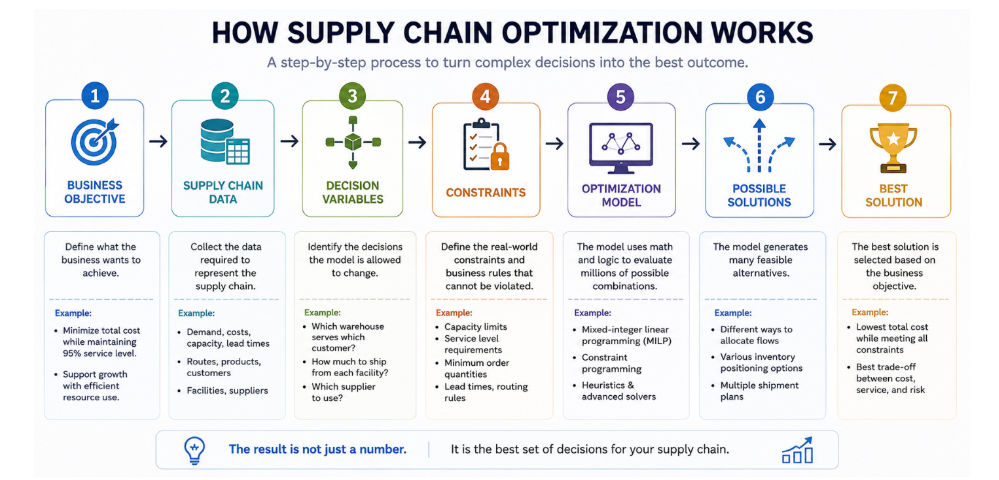
Consider a retailer with four distribution centers, 10,000 SKUs, several thousand customers, multiple transportation options, and differentiated service commitments. Management wants logistics costs down 10% without hurting customer service.
The obvious move is to attack transportation spend, because that is where the cost is most visible. But the actual decision space is wider. A model can evaluate which warehouse serves which customer, which SKUs flow through which warehouse, how inventory is positioned, which transportation modes are used, how warehouse capacity is consumed, and how service requirements are met — all at once, rather than one at a time.
The result is usually not “spend less on transportation.” It is a combination: reassign certain customers between warehouses, change some SKU-to-warehouse flows, consolidate selected shipments, reposition inventory, and use capacity differently across facilities. The business can then compare the current network against the optimized scenario directly.
Indexed against a baseline of 100, a typical outcome looks like this:
Measure | Current network | Optimized scenario |
Total supply chain cost | 100 | 91 |
Transportation cost | 100 | 88 |
Inventory | 100 | 93 |
Capacity utilization | 71% | 84% |
Service level | 96.2% | 96.4% |
Illustrative figures, shown to demonstrate the shape of the result rather than a guaranteed outcome. The point is that no single metric was targeted. The model found a better combination of decisions across the network, and the cost reduction came from five changes acting together rather than one large cut.
Technology investment in operations disappoints more often than most teams expect. In PwC’s 2025 Digital Trends in Operations Survey of 610 operations and supply chain leaders, 92% cited at least one reason their technology investments had not delivered the expected results — most commonly integration complexity (47%) and data issues (44%). Optimization projects fail in recognizable ways:
None of these are mathematical problems. They are project problems which is why the modeling approach matters less than data readiness, explainability, and a clear owner for implementation.
For a small supply chain, spreadsheets and manual analysis can evaluate the realistic alternatives. But complexity grows faster than intuition. Ten thousand SKUs across five thousand customers and ten facilities, with multiple sourcing and transportation options, produces more possible combinations than any team can test by hand.
Supply Chain Optimization software makes that search tractable — evaluating large numbers of combinations against defined constraints and objectives, and doing it repeatably. The goal is not to automate calculation. It is to make complex decisions practical enough to revisit whenever the business changes.
The best platform is not the one with the most features. It is the one that can faithfully represent the decision problem your business actually needs to solve.
An optimization project has to produce measurable business value, not just a better model. The returns come from two places.
Direct financial benefits — transportation cost reduction, inventory reduction, warehouse cost reduction, procurement savings, production efficiency, and avoided capital expenditure.
Operational benefits — improved service levels, better capacity utilization, shorter lead times, stronger network resilience, and faster decision-making.
And not every benefit shows up as a direct saving: if a network model demonstrates that expanding an existing facility supports future growth more economically than building a new distribution center, the avoided capital expenditure belongs in the business case even though no cost line falls.
A strong business case starts with the business problem, not the technology: identify the problem, establish the current baseline, build the model, identify improvement opportunities, quantify the financial and operational benefits, estimate implementation cost, calculate ROI, and then measure what was actually realized. That last step is the one most often skipped, and it is the one that separates theoretical value from delivered value.
Wondering what optimization would be worth in your network? We can build a baseline model and quantify it before you commit.Talk to us →
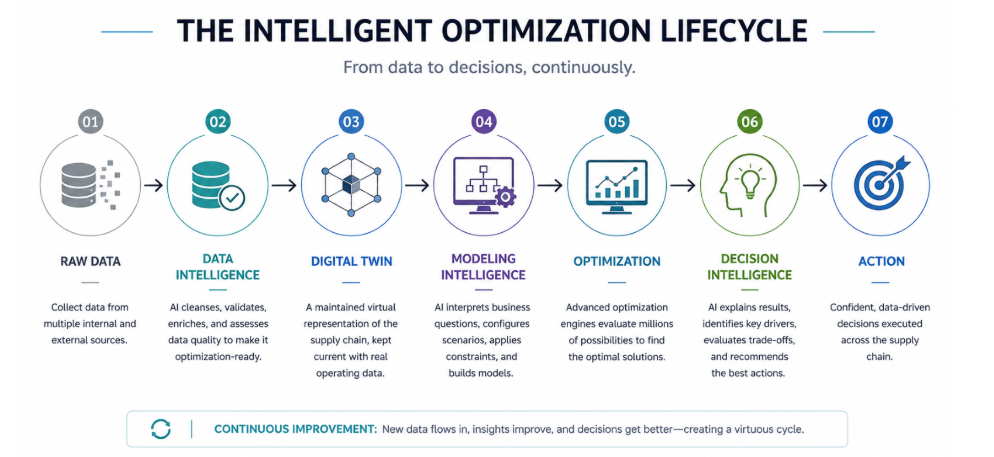
A Digital Twin is a maintained virtual representation of the supply chain one that stays connected to operating data rather than being rebuilt for every project. It allows organizations to test questions such as: What happens if demand rises 20%? What if a warehouse reaches capacity? What if transportation costs increase? What if we add a new facility? These scenarios can be evaluated virtually before changes are made to the physical network. PwC found that only 21% of operations leaders currently use digital twins, while 97% of those users say they are somewhat or very effective in creating value. (PwC)
But a Digital Twin alone does not make a supply chain intelligent. AI can add intelligence across the optimization lifecycle from preparing the data to building models and turning results into decisions.
1. Data Intelligence – Make the Data Optimization-Ready
Optimization is only as reliable as the data behind it. AI can help identify missing data, inconsistent master data, duplicates, outliers, incorrect coordinates, and other issues before they reach the optimization model.
Instead of spending days manually cleaning and validating data, AI can help assess, cleanse, enrich, and prepare data for modeling. Lambda’s Euler, for example, provides data-quality assessment, anomaly detection, master-data validation, and readiness checks.
2. Modeling Intelligence – Turn Questions into Scenarios
Once the data is ready, AI can help translate business questions into models and scenarios.
Instead of manually configuring every assumption, users can ask:
“What if we add a new distribution center in Dallas?”
AI can interpret the business request, configure the scenario, apply relevant constraints, and run the optimization to evaluate the impact. Euler’s modeling capabilities include scenario creation, business-rule interpretation, model validation, constraint configuration, and what-if analysis.
3. Decision Intelligence – Turn Optimization Results into Action
Optimization can produce thousands of numbers, but decision-makers don’t need more numbers they need to understand what changed, why it changed, and what they should do next.
AI can interpret optimization results, explain trade-offs, identify opportunities, assess KPI impacts, and generate recommendations in plain language.
For example:
“Why did the optimized network reduce total cost?”
Instead of manually analyzing reports, AI can identify the key drivers and explain the trade-offs behind the recommendation. Euler is designed to interpret optimization results, compare trade-offs, generate recommendations, and produce executive-level summaries.
The direction is therefore moving beyond periodic optimization projects toward continuous, AI-assisted decision-making. But the foundation remains the same: the quality of the data, the accuracy of the model, and the business constraints determine how valuable the resulting decision can be.
At Lambda Vantis Platform, we help businesses model and optimize complex supply chain decisions before making costly changes in the real world. The method runs in five stages: build a detailed model of the supply chain, optimize network and flow decisions against business objectives and constraints, simulate alternative scenarios, compare them on cost, service, inventory, and capacity, and then decide with the trade-offs quantified.
With granular, SKU-level modeling, teams can evaluate how products should flow across suppliers, facilities, transportation networks, and customers — treating the network as an interconnected system rather than a set of functions to be improved separately.
Model it. Optimize it. Decide with confidence.
Supply chain optimization is more than reducing transportation cost or trimming inventory. It is finding the best combination of decisions across a complex network while balancing the objectives and constraints that actually matter to the business — lower total cost, better service, more effective use of capacity, better-positioned inventory, stronger resilience, and room to grow.
But the real value is not the model. It is being able to answer hard questions with confidence: what should we change, what will happen if we do, what are the trade-offs, and which option produces the best business outcome?
The goal was never to optimize one part of the supply chain. It is to make better decisions across the whole system.