
Lambda Supply Chain Listed as a Representative Vendor in Gartner® Market Guide for Supply Chain Network Design Tools
Published Aug 2026
Subscribe to receive latest resources on supply chain design
Supply chain design determines the structure of the supply chain, while supply chain planning determines how that network operates.
Most companies have spent the last decade getting better at planning: better forecasts, tighter inventory policies, more mature S&OP. And yet cost-to-serve keeps climbing and service targets keep slipping.
The reason is simple. Planning can only optimize the supply chain you already have. Every plan is built inside a fixed set of constraints these facilities, this capacity, these suppliers, these lanes. It finds a better answer inside those constraints; it cannot change them. When the constraints themselves are wrong, better planning just gets you to the ceiling faster.
That is the difference between Supply Chain Planning and Supply Chain Design. Planning works within the network. Design decides what the network should be.
Supply Chain Design answers what should our supply chain look like? Supply Chain Planning answers how should we operate it?
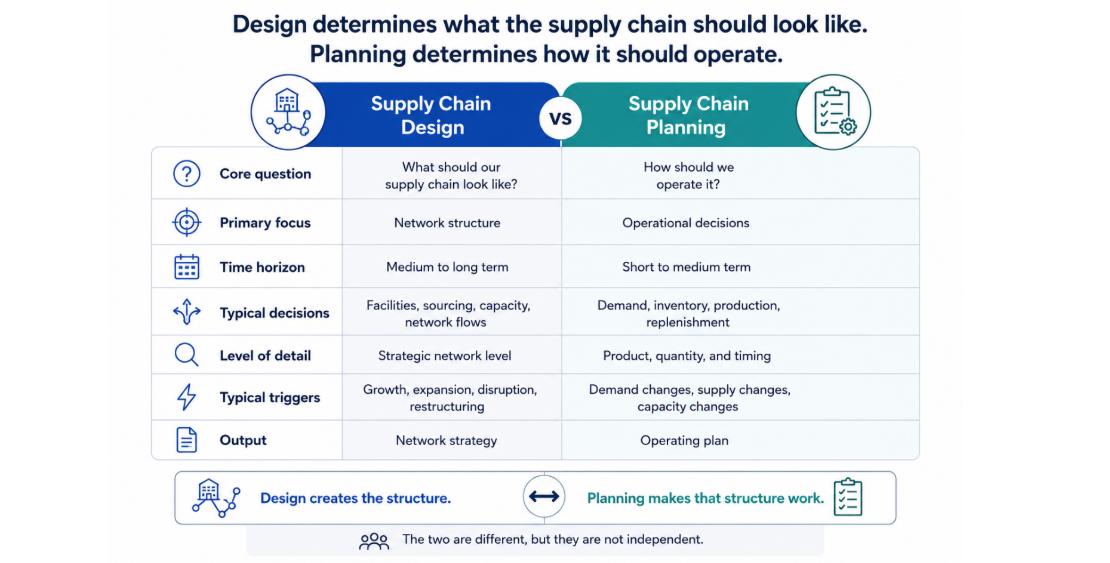
Design creates the structure. Planning makes that structure work. The two are different, but not independent — and the boundary between them is where most supply chain problems actually live.
Supply Chain Design determines how a supply chain should be structured to support the business it serves: where facilities are located, how many are needed, which suppliers to use, where inventory sits, and how capacity is distributed.
The objective is not the lowest-cost network. A good design balances cost against service, resilience, and where the business expects to be in three to five years. Optimizing for cost alone produces a network that works beautifully until the first thing goes wrong.
Supply Chain Planning determines how to operate that structure well. Once the network, facilities, and suppliers exist, planning decides how available resources are used to meet expected demand what to produce, how much inventory each location holds, when to replenish, and which facility serves which demand.
Design is concerned with structure; planning is concerned with quantities, timing, and allocation inside that structure.
Design decisions shape the physical structure of the network. They commit capital and constrain operations for years:
Planning decisions operate at a finer resolution and a shorter horizon:
They run on the same data. Demand history, cost-to-serve, lead times, and capacity feed both. Companies with a trusted data foundation get better plans and better designs. Companies without one get neither.
S&OP connects Planning and Design. It brings demand, supply, inventory, and capacity decisions together and can reveal problems that planning alone cannot solve.
For example, if a warehouse repeatedly exceeds capacity despite better inventory and allocation plans, S&OP can raise a bigger question:
Is the network itself still right for the business?
That may trigger a Design decision – such as adding a facility, expanding capacity, or changing customer allocation.
Planning identifies the problem. S&OP surfaces it. Design evaluates the structural solution.
They remain different jobs. Planning runs weekly to monthly, owned by planners and S&OP leads. Design runs annually and event-driven, and needs modeling skills. Expecting one team to do both is why network questions get deferred indefinitely.
Not every supply chain problem needs a new network. Often the plan really is the issue. But when the same problem returns month after month despite competent planning, the network is the problem.
Warning signs worth taking seriously:
That last one is the most reliable indicator and the easiest to miss heroic planning masks structural problems, which is exactly why it delays fixing them. When these patterns persist, the question stops being how do we improve the plan? and becomes is this network still right for the business?
Consider a hypothetical retailer running three distribution centers, mid-peak season. Its largest DC suffers a fire and shuts down. Roughly 40% of fulfillment capacity is gone with no notice, and the two remaining DCs have limited headroom.
The first questions are planning questions: how should available inventory be allocated, which customers get served from which facility, and how do replenishment plans change this week?
But within days the design questions arrive. Lease temporary 3PL space, and where? Reposition inventory, or reassign customer territories? Can the surviving facilities absorb the volume at acceptable cost and service?
These are not questions to answer by instinct under pressure. Each option moves transportation cost, capacity, and service in different directions. Design evaluates the alternatives; planning then runs whichever one is chosen.
Modern supply chain systems apply the same underlying engine optimization to both planning and network design. That is why the two are often confused with each other, and with optimization itself. Optimization is neither. It is a method that applies to both.
Design optimization asks: where should we locate distribution centers to minimize total cost while meeting service requirements? Planning optimization asks: given our existing distribution centers and current demand, how should inventory and shipments be allocated?
Same mathematics, different decision variable which is why the quality of the design sets the ceiling on what planning can achieve.
Design and planning are usually drawn as sequential. In practice the relationship is a loop: design creates the network, planning operates it, execution moves the product, measurement tracks performance, and learning identifies where the assumptions have stopped holding which triggers redesign.
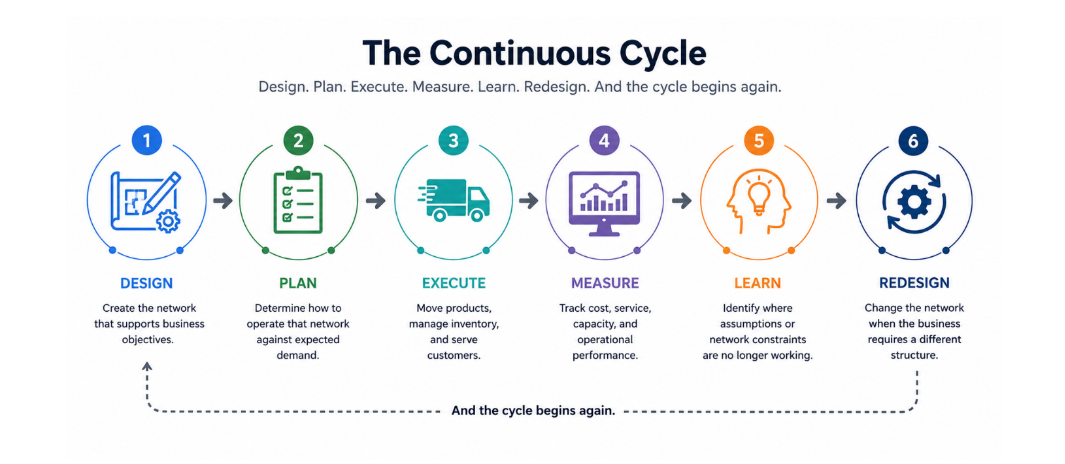
Planning does not only operate the network it produces the evidence that tells you when the network needs to change. Treat design as a one-time project and you lose that feedback loop entirely.
Refresh the model annually against actual cost, demand, and service data to confirm the structure still holds up. Revisit quarterly if you are growing fast, entering new markets, or shifting your sourcing footprint. And model immediately when any of the warning signs above appear.
Network change is no longer occasional. Gartner found that 73% of companies added or removed production locations in the previous two years. Restructuring is now routine, not a once-a-decade capital project.
But the decisions are hard to make with confidence: a later Gartner survey found 72% of supply chain leaders revisited final approvals for network decisions at least once, over half three or more times. Decisions get relitigated when the trade-offs were never made explicit. Modeling the alternatives up front prevents that.
A company can run a sophisticated planning process and still lose money every month if its warehouses are in the wrong places or its sourcing no longer matches where demand is. Equally, a well-designed network underperforms when demand is forecast poorly.
Lambda connects supply chain design, and optimization to help teams evaluate network decisions before implementation. Teams can model different scenarios and compare trade-offs across cost, service, capacity, and resilience.
With Lambda, organizations can evaluate:
Using network modeling, optimization, and scenario analysis, Lambda helps teams identify whether a supply chain problem can be solved through planning or requires a structural network change.
Explore Lambda Supply Chain Design Software to model, compare, and optimize your supply chain network.
Planning makes the best decisions available inside the existing supply chain. Design asks whether that supply chain is still the right one. When demand shifts, markets expand, or disruption exposes a weakness, the honest answer is sometimes that the plan is fine and the network is not — and the strongest supply chains recognize that difference early.