
Lambda Supply Chain Listed as a Representative Vendor in Gartner® Market Guide for Supply Chain Network Design Tools
Published Sep 2026
Subscribe to receive latest resources on supply chain design
E-commerce has transformed customer expectations. Two-day, next-day, and same-day delivery are increasingly common, while businesses still need to control logistics costs, inventory, and margins.
Meeting these expectations creates a fundamental question: How should an e-commerce network be designed to deliver the right customer experience at the right total cost?
Adding fulfillment centers may improve speed, but it also increases fixed costs and inventory complexity. The challenge isn’t simply building a faster network. It’s designing one that balances speed, cost, inventory, capacity, and customer expectations.
E-commerce supply chain network design is the process of determining how products should flow from suppliers and manufacturing facilities through fulfillment centers to customers.
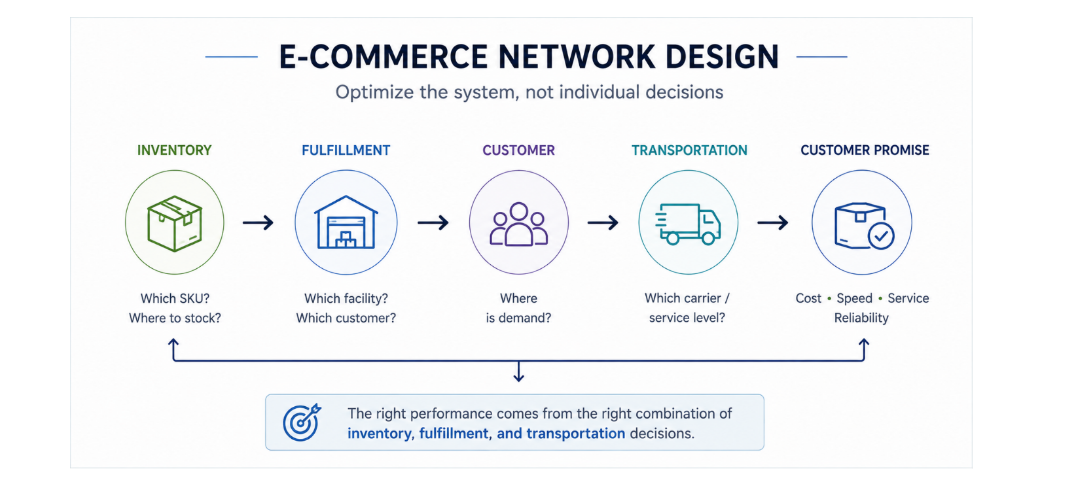
Unlike traditional distribution, e-commerce networks often operate at a much more granular level. A single network may contain thousands of SKUs, large numbers of geographically dispersed customers, multiple fulfillment options, and different delivery promises.
That makes supply chain design less about drawing facilities on a map and more about determining how the entire fulfillment system should work together.
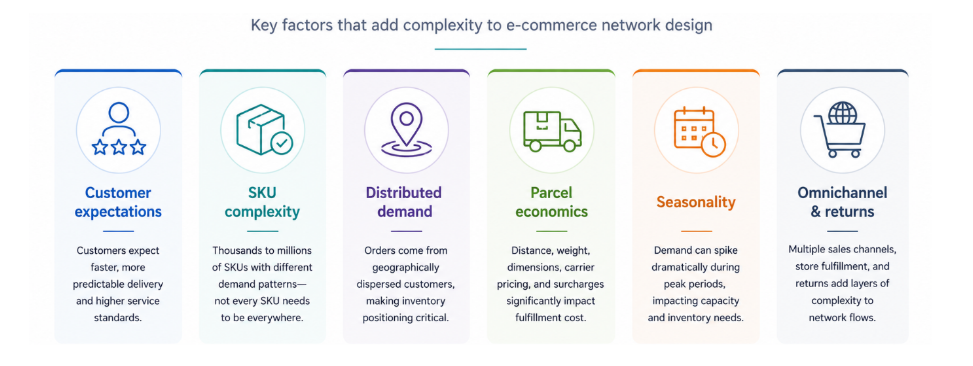
E-commerce networks are more complex because they combine high SKU variety, geographically dispersed demand, faster delivery expectations, parcel economics, seasonal peaks, and omnichannel or returns flows.
These factors make inventory positioning and fulfillment decisions far more granular than in traditional distribution.
A high-performing e-commerce supply chain network is built around several interconnected decisions.
1. Facility Strategy
Where should fulfillment centers be located, expanded, or outsourced?
2. Inventory Strategy
Which products should be stocked at which facilities?
3. Customer Allocation
Which facility should serve which customer or market?
4. Transportation Strategy
How should products move between facilities and customers?
5. Service Strategy
What delivery promise should the network support?
These decisions are connected.
E-commerce network design is therefore a system problem not a single facility decision.
One of the biggest mistakes in e-commerce network design is optimizing for a single metric.
Consider a business trying to improve delivery speed.
It could open several regional fulfillment centers and position inventory closer to customers.
Delivery times may improve.
But now the company also has:
More facilities → higher fixed costs
More inventory locations → higher inventory investment
More complex operations → greater coordination requirements
The same trade-off works in the opposite direction.
Centralizing inventory may reduce operating and inventory costs, but it can increase transportation distance and delivery time.
This is why e-commerce network design has to balance:
Cost ↔ Service ↔ Inventory ↔ Capacity ↔ Resilience ↔ Sustainability
The optimal network isn’t necessarily the cheapest network or the fastest network.
It is the network that provides the best overall business outcome.
A structured network design process can turn this complexity into a set of manageable decisions.
1. Define the Customer Promise
Start with the outcomes the network must support.
For example:
Two-day delivery for 95% of orders.
This becomes a design requirement rather than simply an aspiration.
2. Understand Demand
Analyze where demand comes from and how it varies by:
The goal is to understand not only how much demand exists, but where and when it occurs.
3. Understand Product and Inventory Characteristics
Not every SKU behaves the same way.
A fast-moving product may justify regional stocking, while a low-volume product may be more economical to centralize.
SKU-level analysis is therefore critical.
4. Model Facilities and Capacity
Evaluate existing and potential fulfillment facilities based on location, capacity, operating cost, and service requirements.
5. Design Product Flows
Determine how products should move from suppliers through facilities to customers.
At this stage, the network can be evaluated at a granular level:
Supplier → SKU → Fulfillment Center → Customer
6. Evaluate Transportation and Service Costs
Understand how different network structures affect parcel volume, transportation cost, delivery time, and service performance.
7. Compare Scenarios
Test alternative network configurations before committing to one.
This is where optimization and scenario analysis become particularly valuable.
Before making a major network investment, businesses can ask:
What if demand grows by 30%?
What if we open a fulfillment center in a new region?
What if a carrier increases rates?
What if we move fast-moving SKUs closer to customers?
Instead of evaluating these questions independently, a network model can compare how each scenario affects cost, service, inventory, capacity, and other business objectives.
A Digital Twin can extend this capability by providing a maintained virtual representation of the supply chain in which different network configurations can be tested before changes are made in the physical network.
The goal is simple:
Test the network before you invest in the network.
Consider an e-commerce retailer with two fulfillment centers serving customers across the country.
The business has seen rapid order growth, while delivery performance is beginning to decline.
Leadership is considering three options.
Scenario A — Add a New Fulfillment Center
A new regional facility could reduce delivery distances and improve service.
But it also adds fixed operating costs and may require additional inventory.
Scenario B — Reposition Inventory
Instead of building a new facility, the company could move high-volume SKUs closer to regions with the greatest demand.
This may improve service with less capital investment.
Scenario C — Combine Inventory and Transportation Changes
The company could reposition selected SKUs, reassign customers across facilities, and optimize parcel flows and carrier choices.
Now the question is not:
“Which option is cheapest?”
It becomes:
“Which scenario delivers the required customer experience at the best total cost?”
A network optimization model can evaluate those alternatives simultaneously—down to SKU, facility, customer, and product-flow decisions—and reveal the trade-offs that are difficult to see through manual analysis.
The best solution may not be a new warehouse.
It may be a different combination of inventory, flows, facilities, and transportation.
The complexity of e-commerce networks quickly makes manual analysis difficult.
When a model contains thousands of SKUs, customers, facilities, lanes, capacities, and constraints, the number of possible configurations becomes too large to evaluate one by one.
Modern supply chain technology combines:
Data → Digital Twin → Optimization → Scenario Simulation → Comparison → Decision
Optimization searches for optimal solutions against defined objectives and constraints.
Scenario modeling allows businesses to compare alternative futures.
Digital Twins provide a virtual environment for testing network changes.
And AI can help users move through the process faster—from preparing the data to interpreting the final results.
AI’s role in supply chain optimization goes beyond explaining results.
It can support three critical areas.
Data Intelligence
AI can help identify missing data, anomalies, inconsistent master data, incorrect coordinates, and other quality issues before they affect an optimization model. Lambda’s Euler provides capabilities including data-quality assessment, outlier identification, master-data validation, data enrichment, missing-data detection, and readiness checks.
Modeling Intelligence
AI can help translate business questions into scenarios and models.
For example:
“Create a scenario with a new fulfillment center in Dallas.”
Euler is designed to interpret business rules, create scenarios, configure constraints, validate models, and support what-if analysis.
Decision Intelligence
Optimization may produce complex outputs, but decision-makers need to understand what they mean.
AI can interpret results, explain trade-offs, assess KPI impacts, identify opportunities, and generate recommendations in plain language. Euler’s Decision Intelligence capabilities are designed around these functions.
This creates a more intelligent lifecycle:
Raw Data → Data Intelligence → Digital Twin → Modeling Intelligence → Optimization → Decision Intelligence → Action
The fastest e-commerce network isn’t necessarily the best network.
The cheapest network isn’t necessarily the best network either.
A high-performing network balances customer expectations with the economics of fulfillment.
That means looking beyond facility location to the decisions that truly shape e-commerce performance:
The objective is not to build more warehouses.
It is to build the right supply chain network.
Designing an e-commerce supply chain network requires more than deciding where to place fulfillment centers. Organizations need to understand how facility locations, inventory, customer allocation, transportation, capacity, and service requirements work together.
Our Supply Chain Network Design Software brings network modeling, optimization, scenario analysis, and AI-powered decision intelligence into one environment—helping supply chain teams evaluate complex network decisions with greater speed and confidence.
With Lambda Vantis, teams can:
Instead of relying on spreadsheets and manual analysis, teams can test the network before investing in the network—and make faster, more informed decisions about how their e-commerce supply chain should evolve.