
Lambda Supply Chain Listed as a Representative Vendor in Gartner® Market Guide for Supply Chain Network Design Tools
Published Oct 2026
Subscribe to receive latest resources on supply chain design
From disconnected data and individual analyses to one shared model for better supply chain decisions
Supply chain decisions rarely belong to one team.
Procurement manages suppliers and sourcing. Operations manage plants and capacity. Logistics manages transportation. Inventory teams manage stock and service levels. Finance looks at cost and investment. Sales focuses on customer commitments.
Each team has a different view of the same supply chain.
The problem isn’t necessarily a lack of data. It is that the data, assumptions, and models used to make decisions are often fragmented. Lambda identifies siloed or incomplete data, reactive analysis, manual processes, and limited engagement with complex tools as important challenges in managing increasingly interconnected supply chains.
Now consider a simple question:
What happens if we add a new distribution center?
Operations may look at capacity.
Logistics may calculate transportation savings.
Inventory may estimate additional stock requirements.
Finance may evaluate the investment.
Each analysis may be reasonable on its own but what if everyone could evaluate the same question using the same representation of the supply chain? That’s where a Supply Chain Digital Twin becomes valuable.
A Supply Chain Digital Twin is a maintained digital representation of the supply chain that captures its key structures, relationships, data, constraints, and behavior closely enough to evaluate different decisions before changing the physical network.
It can represent elements such as:
Suppliers → Plants → Warehouses → Transportation → Customers
along with:
SKUs • Demand • Inventory • Capacity • Costs • Service Requirements
A Digital Twin can provide the environment in which analytics, simulation, optimization, and scenario planning are applied to a common representation of the supply chain.
The objective is not to create a perfect digital replica of every physical detail.
It is to create a model that is accurate enough for the decisions the business needs to make.
A collaborative Supply Chain Digital Twin is more than a model that multiple people can access.
It creates a shared decision environment where different functions can contribute their knowledge while evaluating the same supply-chain scenario.
For example:
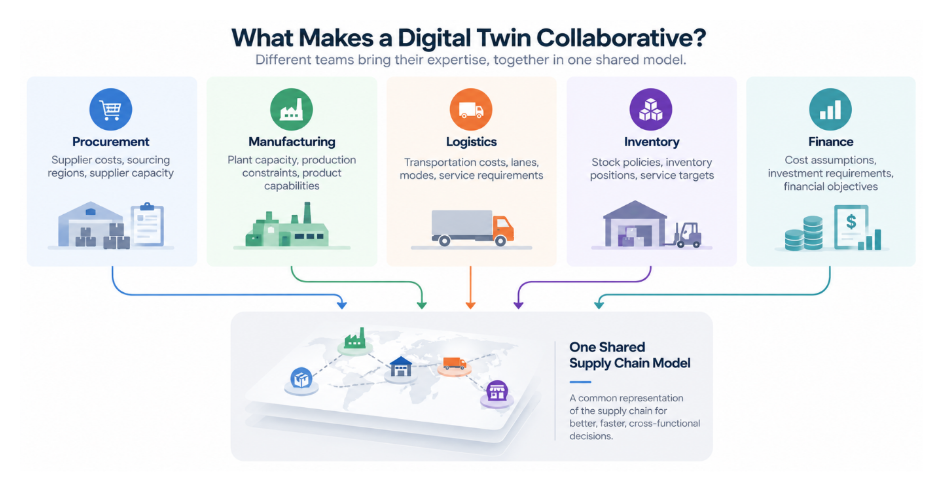
Supply-chain decisions often cross functional boundaries. A sourcing change can affect transportation and inventory; a facility change can affect capacity and customer allocation. A collaborative Digital Twin gives teams one model to evaluate those interactions.
Different teams can bring different perspectives without creating different versions of the supply chain.
A Digital Twin is only useful if it represents the parts of the supply chain that matter to the decision.
At a basic level, the model may look like:
Supplier → Plant → Warehouse → Customer
But business decisions often require more detail.
Which SKU moves through which facility?
Which customers are served by which warehouse?
What capacity is available?
What transportation costs apply?
What service requirements must be met?
What sourcing rules or business constraints apply?
For a complex supply chain, the relationships between these elements are as important as the elements themselves.
A facility or supplier is more than a point in the network. Its capacity, cost, location, inventory, lead time, customers, and product flows can all affect decisions across the network.
Building the technology is only one part of the challenge.
For a Digital Twin to become useful, five things matter.
Poor data makes the twin unreliable.
Too little detail limits decisions; too much makes the model difficult to maintain.
The model must reflect actual constraints and policies.
Teams need to trust and contribute to the model.
A stale twin becomes another static model.
The goal isn’t to build the most sophisticated Digital Twin. It’s to build one that reflects reality, stays useful, and supports decisions.
These technologies are complementary, not interchangeable.
Capability | Primary Question |
Dashboard | What is happening? |
Simulation | What could happen? |
Optimization | What is the optimal decision? |
Digital Twin | How does the supply chain work, and how could it respond? |
These capabilities are complementary: simulation explores what could happen, optimization identifies the optimal decision, and the Digital Twin provides the common representation in which those analyses can be performed.
AI can make Digital Twins more accessible by helping across the optimization lifecycle.
Data Intelligence
AI can help identify missing values, anomalies, inconsistent master data, and other quality issues before they affect the model.
Lambda’s Euler provides capabilities including data-quality assessment, outlier identification, master-data validation, data enrichment, missing-data detection, constraint validation, and readiness checks.
Modeling Intelligence
AI can help turn business questions into scenarios.
For example:
“What happens if we add a new distribution center in Dallas?”
Euler supports scenario creation, business-rule interpretation, model validation, constraint configuration, assumption management, and what-if analysis. (Lambda Supply Chain)
Decision Intelligence
Supply Chain Optimization can generate complex results, but users need to understand the implications.
AI can help explain trade-offs, identify opportunities, assess KPI impacts, and communicate recommendations in business language. Euler provides result interpretation, trade-off analysis, opportunity identification, executive summaries, and recommendation generation. (Lambda Supply Chain)
This creates a more intelligent path:
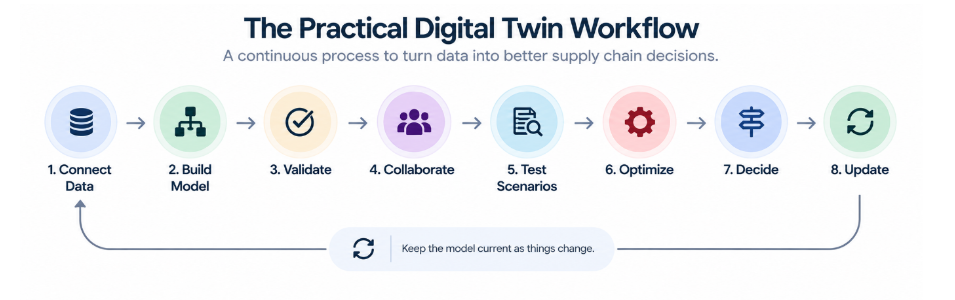
Data → Digital Twin → Scenarios → Optimization → Insights → Decisions
The role of AI is not to replace the Digital Twin or optimization engine.
It is to make the entire process faster, more accessible, and easier to act on.
Lambda Lab provides an environment for modeling and evaluating supply-chain decisions across facilities, products, customers, flows, capacity, transportation, and other constraints.
The objective is not simply to create another digital model.
It is to give teams a shared representation of the supply chain that can be used to:
With granular network modeling, organizations can evaluate decisions at the level their supply chain requires including SKU, customer, facility, and product-flow relationships.
Euler adds an AI intelligence layer across data preparation, modeling, scenario analysis, and decision interpretation.
Different teams can bring their own expertise while working from the same underlying model.
Lambda Lab is ideal for companies seeking a cost-effective, cloud-based supply chain design solution with faster implementation, easy-to-use modeling, and responsive customer support.
Combines AI-powered data preparation, digital twin modeling, scenario analysis, and network optimization to help businesses make smarter supply chain decisions faster.
A Digital Twin isn’t successful because it looks like the physical supply chain.
It is successful when the business can trust it, use it, and make decisions from it.
The real value comes from bringing together:
Shared Data → Shared Model → Shared Scenarios → Shared Understanding → Better Decisions
The goal isn’t to build another model. It’s to build a model the business can use together.