
Lambda Supply Chain Listed as a Representative Vendor in Gartner® Market Guide for Supply Chain Network Design Tools
Published Sep 2026
Subscribe to receive latest resources on supply chain design
Supply chain costs rarely sit in one place.
A company may be spending more on transportation, carrying excess inventory, underutilizing manufacturing capacity, or paying higher supplier costs than necessary. Each function may already have its own cost-reduction initiative, yet the total supply chain cost may continue to rise.
For the CFO, this creates a difficult question:
Where is the real opportunity and what is driving it?
The challenge is that supply chain costs are interconnected. A lower supplier price can come with higher transportation costs. Reducing inventory can increase expedites. Higher plant utilization can increase freight. Adding a warehouse can improve service while increasing fixed costs and working capital.
Finance needs visibility into these relationships because supply-chain decisions ultimately affect margins, working capital, capital expenditure, and financial performance. Recent CFO-focused supply-chain research similarly emphasizes the need to connect operational decisions with their financial consequences rather than viewing supply-chain risk and cost in isolation.
This is where Supply Chain Network Design can become a powerful financial decision tool.
Supply Chain Network Design is often viewed as a supply-chain function: deciding where to place facilities, how products should flow, or which suppliers and warehouses should serve customers.
But from a CFO’s perspective, it can answer a much broader question:
How is the structure of the supply chain affecting total cost and what would happen if we changed it?
A network model can connect decisions across:
This creates a financial view of the network rather than looking at cost categories independently.
For example, the cheapest supplier may not have the lowest landed cost once inbound transportation and inventory are considered. Likewise, consolidating facilities may reduce fixed costs but increase outbound transportation and delivery times.
Supply Chain Network Design helps model these relationships and quantify the trade-offs before the business commits to a change.
Network Design turns supply-chain complexity into a map of financial opportunities.
The opportunity can exist across several interconnected cost pools.
Area | Questions Network Design Can Answer |
Sourcing | Which suppliers and sourcing regions provide the best overall economics? |
Manufacturing | Where should products be made, and how should capacity be allocated? |
Transportation | How should products move across the network at the lowest total cost? |
Inventory | Where should inventory be positioned to balance cost and service? |
The important point is that these are not independent cost pools.
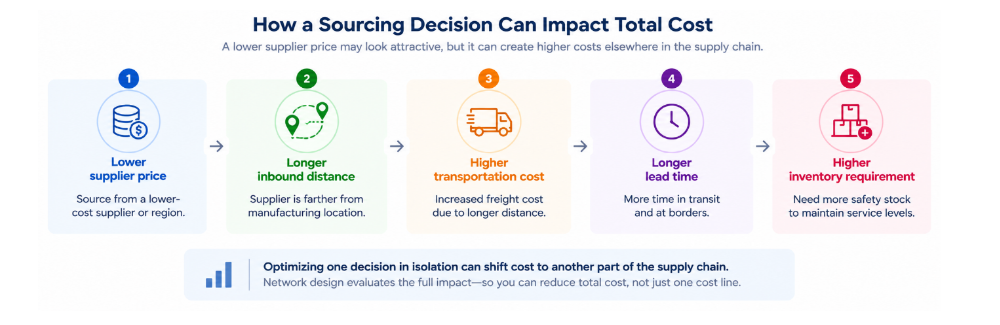
The initial saving may look attractive in procurement, but the total supply-chain impact could be very different.
The same applies to inventory. Reducing stock may lower working capital, but if it creates stockouts and expedited shipments, some of the savings can disappear.
That is why the biggest opportunity may not come from optimizing one function.
It may come from changing the combination of decisions across the supply chain.
A traditional cost-reduction exercise often starts with a line item:
Transportation is too expensive.
So the business negotiates freight rates.
Or:
Inventory is too high.
So inventory targets are reduced.
Or:
Supplier costs are too high.
So procurement negotiates a lower price.
These actions can create savings but they can also shift cost somewhere else.
Network Design starts with the end-to-end system.
Instead of asking only:
“Where can we cut cost?”
it asks:
“What is causing the cost, and what changes to the network could reduce total cost?”
For example, a manufacturing model may show that moving production of selected SKUs to another plant reduces total cost despite a slightly higher production cost, because the resulting transportation and inventory savings are greater.
Likewise, a network model may show that closing a warehouse saves facility expense but creates enough additional transportation and service costs to make the change unattractive.
The value lies in seeing the full economic consequence of the decision.
A practical network-design exercise can move from an existing cost baseline to a quantified opportunity.
This is where a supply chain network model can expose opportunities that are difficult to identify from functional reports alone.
For some organizations, this analysis may uncover a material double-digit (10-30%) cost-reduction opportunity, but the actual percentage depends heavily on the starting network, business objectives, constraints, and changes required. A credible business case should therefore establish the opportunity through modeling rather than assume a specific savings percentage upfront.
A supply chain network optimization model may identify a significant cost-reduction opportunity. But an opportunity only becomes valuable when the business can understand its impact, test the alternatives, and determine what can realistically be captured.
Start with the current baseline and model potential changes across sourcing, manufacturing, transportation, inventory, and network structure. Then test scenarios such as:
Each scenario should be evaluated not only for cost, but also for service, capacity, inventory, and other business constraints.
The distinction between gross opportunity and realizable savings is critical. A model may identify $20 million in potential annual savings, but contracts, transition costs, capital requirements, labor, technology, or implementation timelines may reduce what the business can actually capture.
A strong business case therefore doesn’t start with the technology. It starts with the problem, establishes the baseline, quantifies the opportunity, accounts for the cost of change, and measures the value ultimately realized.
Don’t just identify the saving. Prove what is worth changing.
For the CFO, the challenge is rarely knowing that supply chain costs are high. The harder question is where those costs can be reduced without simply shifting them somewhere else.
AI-enabled Network Design can help supply chain teams answer that question faster. It can bring together supply-chain data, network constraints, optimization, and scenario analysis to identify opportunities across sourcing, manufacturing, transportation, inventory, and facilities. Lambda’s Euler is designed to support this process across data preparation, scenario modeling, optimization analysis, and decision support. (Lambda Supply Chain)
Data Intelligence helps teams establish a more reliable cost baseline by identifying missing data, anomalies, inconsistent master data, and other issues that could distort the analysis.
Modeling Intelligence helps teams test financial questions such as What if we change our sourcing mix? What if we consolidate facilities? What if we reposition inventory? Euler supports scenario creation, business-rule interpretation, constraint configuration, and what-if analysis.
Decision Intelligence turns the resulting analysis into business insight—showing where savings come from, what trade-offs they require, and which opportunities have the greatest potential impact. Euler supports result interpretation, trade-off analysis, opportunity identification, KPI impact assessment, and recommendation generation.
For the CFO, the outcome is a clearer path from:
Supply Chain Data → Cost Drivers → Optimization Opportunities → Financial Impact
The value is having a quantified view of where the supply chain can create financial improvement—and the evidence needed to decide which opportunities are worth pursuing.
Finding a supply chain cost-reduction opportunity requires more than looking at individual expense categories.
It requires seeing how sourcing, manufacturing, transportation, inventory, facilities, demand, and service requirements interact.
Lambda Vantis brings these capabilities together in an AI-powered supply chain network design software.
With Lambda Vantis, organizations can model their current network, evaluate alternative scenarios, optimize decisions against business objectives, and quantify the potential financial impact before committing to change.
Organizations can use network design to evaluate questions such as:
For CFOs, this creates a more direct connection between supply chain decisions and financial outcomes.
Supply chain cost reduction does not always require another isolated procurement initiative, freight negotiation, or inventory program.
Sometimes, the opportunity is hidden in the structure of the supply chain itself.
Network design can reveal how decisions across sourcing, manufacturing, transportation, inventory, and facilities interact—and show what could happen if the network were configured differently.
For a CFO, the question is not simply:
“Where can we cut cost?”
It is:
“Where is cost being created, what can we change, and what value can we realistically capture?”
That is where network design becomes more than a supply chain planning tool.
It becomes a tool for finding financial opportunity.
Lambda Supply Chain helps organizations move from supply chain complexity to quantified opportunity with Lambda Vantis.
Model your network. Test the alternatives. Quantify the opportunity. Make the decision with evidence.
Explore Lambda Vantis or talk to the Lambda Supply Chain team to see where your next supply chain cost-reduction opportunity could be.