Lambda Supply Chain Listed as a Representative Vendor in Gartner® Market Guide for Supply Chain Network Design Tools
Published Nov 2026
Subscribe to receive latest resources on supply chain design
AI won’t replace your optimization model. Here’s what it does instead, and how the two together improve supply chain design and planning decisions.
Picture a procurement team that switches to a lower-cost supplier. On paper, the savings are clear. In practice, the new supplier is farther away, so inbound freight rises, lead times stretch, safety stock goes up, and production schedules have to be reworked. The unit-price saving shrinks, or disappears.
This is the core challenge of supply chain management. Thousands of decisions across suppliers, manufacturing facilities, warehouses, inventory, and transportation networks all affect one another. Opening a new distribution center changes customer allocation, transportation costs, and inventory positioning. Changing a supplier changes material costs, lead times, and production schedules.
Traditionally, evaluating these knock-on effects has required data from multiple systems, specialized analytical tools, mathematical models, and considerable manual effort. As a result, many decisions are still made one function at a time.
Artificial Intelligence (AI) is changing that, but not in the way many people assume.
AI doesn’t replace the mathematical optimization engine that weighs possible decisions against costs, capacities, and constraints. Instead, it prepares and validates data, turns business questions into scenarios, and explains results in plain language. Optimization and simulation then do what they do best: identify the best decisions and test them under alternative conditions.
AI doesn’t replace the optimization engine. It makes it faster to set up and easier to understand.
AI-driven supply chain decision-making combines artificial intelligence, predictive analytics, mathematical optimization, and simulation to improve how businesses evaluate and make decisions.
Each technology plays a distinct role:
Together, these technologies apply across the two core areas of supply chain decision-making:
Supply Chain Design: Deciding how the supply chain should be structured, including facilities, suppliers, product flows, and transportation routes.
Supply Chain Planning: Deciding how demand will be met with available materials, capacity, and inventory, from forecasting demand to scheduling production.
Optimization is not a separate area. It runs through both. In design, optimization finds the network and transportation structure that minimizes total cost while meeting service requirements. In planning, it determines how to meet demand with the right inventory, capacity, and cost.
For a deeper look at how design and planning differ, see Supply Chain Design vs. Supply Chain Planning: Why Companies Need Both.
AI’s role varies with the business problem, the available data, and the decisions being evaluated. In both design and planning the pattern is the same: AI prepares the inputs and explains the outputs, while optimization evaluates the decisions.
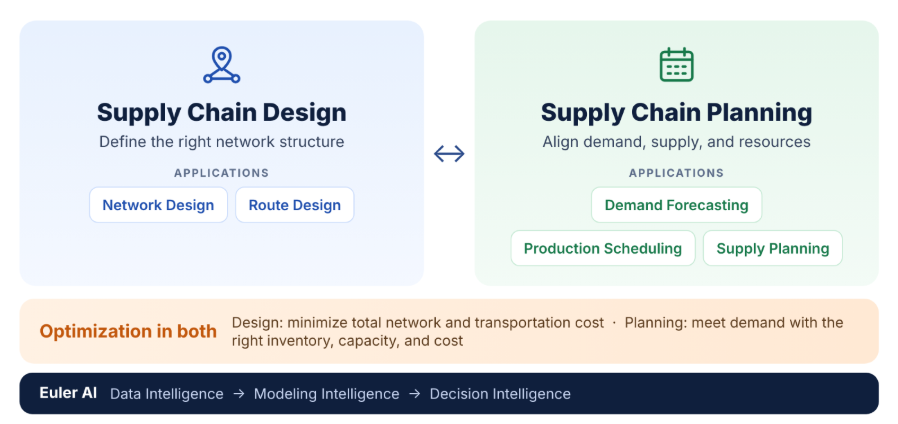
Supply chain design involves strategic decisions about the structure of a company’s network. Network design determines where to locate facilities, which suppliers should serve which locations, how customers should be allocated, and how products should flow. Route design determines how goods move through that network, including transportation modes, shipment flows, and delivery routes.
These decisions shape operating costs, service levels, inventory requirements, and long-term business performance. Optimization finds the configuration with the lowest total cost that still meets service targets.
In supply chain design, AI can:
Example: A company planning to expand into a new region wants to evaluate whether it should establish another distribution center or serve customers through its existing network.
AI prepares the data and sets up the scenarios. Network optimization then evaluates facility locations, customer allocation, transportation costs, and capacity constraints, and AI explains which configuration performs best and why.
Example: A business wants to reduce transportation costs without compromising customer service.
In route design, AI helps users frame alternatives, such as consolidating shipments or shifting transportation modes. Optimization then evaluates shipment flows, modes, and delivery constraints to find the lowest-cost option that still meets delivery commitments.
Supply chain planning translates demand into actionable plans across three connected activities: demand forecasting, supply planning, and production scheduling.
But planning involves more than calculating how much a business needs. Plans must also account for supplier availability, material requirements, production capacity, lead times, and operational constraints. Optimization determines how to meet demand at the lowest cost, with the right inventory levels and the best use of available capacity.
In supply chain planning, AI can:
Example: A manufacturer experiences an increase in demand for several products. However, a key supplier is facing delays, and available production capacity is limited.
Planning models assess material requirements, production capacity, and inventory constraints to determine how much demand can be fulfilled, and how. AI helps planners test alternative assumptions, such as expediting from a second supplier or adding overtime shifts, and explains the trade-offs in the resulting plans.
Because optimization runs through both design and planning, decisions shouldn’t be made in isolation. A network or routing change affects inventory and supply plans, and every plan depends on the network it runs on. Evaluating these relationships together reveals the wider implications of each decision.
Learn more in Supply Chain Planning and Optimization: How They Work Together to Cut Costs.
Want to see this on your own network? Request a free demo of Lambda Lab and Euler AI.
Combining AI with optimization across design and planning improves decision-making in four areas:
Better Cost and Resource Utilization
Evaluate sourcing, production, inventory, and transportation decisions together to identify opportunities to improve resource allocation and manage costs.
Faster Scenario Evaluation
Cut the manual effort involved in preparing data, configuring scenarios, and comparing alternatives, so teams can evaluate more options in less time.
Greater Visibility Into Trade-offs
Understand how changes in one area affect other supply chain functions, including cost, capacity, inventory, and service.
More Informed Business Decisions
Make complex analytical results easier to interpret, helping business leaders and operational teams evaluate alternatives with greater confidence.
These benefits depend on reliable data, appropriate models, and how recommendations are implemented. AI supports better decisions, but it does not eliminate business uncertainty or replace the need for human judgment.
Despite its potential, implementing AI across supply chain operations requires careful consideration.
Data Quality: AI and optimization models depend on accurate and consistent information. Missing or incorrect data can affect the reliability of results.
Model Accuracy: Business objectives, assumptions, and constraints must accurately reflect real operating conditions.
Integration: Data often comes from different enterprise systems. Businesses need reliable ways to connect and maintain this information.
Explainability: Decision-makers need to understand why a recommendation was generated and what assumptions influenced it.
Human Oversight: AI should support business expertise, not eliminate accountability. Important decisions involving investment, service, cost, and risk require appropriate review.
Successful adoption depends on combining AI capabilities with reliable data, suitable analytical methods, and well-defined business processes.
For the leadership perspective on adoption, read The AI-First Supply Chain: What Enterprise Leaders Need to Know in 2027.
Lambda Lab brings AI into its supply chain design software and planning applications through Euler AI.
Rather than limiting AI to a chat interface, Euler AI works at three levels: Data Intelligence, Modeling Intelligence, and Decision Intelligence. To see how they fit together, return to the supplier switch from the start of this article.
Data Intelligence
Data Intelligence prepares and validates the information supply chain models depend on. In the supplier example, it would flag missing lead times or capacity data for the new supplier before any scenario is run. Capabilities include:
Modeling Intelligence
Modeling Intelligence turns business questions into structured scenarios for optimization and simulation. A planner could describe the supplier switch in plain language and have Euler AI configure the sourcing change, the new lead times, and a comparison against the current supplier. Capabilities include:
Decision Intelligence
Decision Intelligence explains optimization results and their business implications. Asked “Why does the cheaper supplier increase total cost?”, it can trace the answer to higher inbound freight, longer lead times, and additional safety stock. Capabilities include:
Together, the three layers follow the decision-making process from start to finish:
Data Intelligence → Modeling Intelligence → Decision Intelligence
Euler AI works across Lambda Lab’s two core modules:
Supply Chain Design
Supply Chain Planning
By bringing AI into these applications, Lambda Lab helps businesses spend less time preparing data and running models, and more time understanding results and making better-informed supply chain decisions.
Explore Lambda Lab and Euler AI.
Supply chain decisions are interconnected. A change in network design can influence inventory and transportation. A change in demand can affect supplier requirements and production capacity. A sourcing decision can influence costs, lead times, and customer service.
By combining artificial intelligence, predictive analytics, mathematical optimization, and simulation in supply chain network design software and planning tools, businesses can design better networks and plan operations around real constraints, with optimization finding the best answer in both.
The future of supply chain decision-making is not about using AI for isolated tasks. It is about connecting intelligence across the supply chain so businesses can understand the wider impact of decisions before acting.
Better supply chains begin with better-connected decisions.
Ready to connect your supply chain decisions? Request a free demo of Lambda Lab and Euler AI.
See how Lambda helps teams model their network, test scenarios and find savings, using your own data.
Request a Free Demo →