
Lambda Supply Chain Listed as a Representative Vendor in Gartner® Market Guide for Supply Chain Network Design Tools
Published Sep 2026
Subscribe to receive latest resources on supply chain design
A supply chain can have a strong demand forecast, well-defined inventory targets, and a detailed production plan and still cost more than it should.
Why?
Because a feasible plan is not necessarily an optimal plan.
A planner may know how much demand needs to be fulfilled, but there can be thousands of ways to source, produce, stock, and distribute that demand. Choosing one option can reduce cost in one area while increasing it somewhere else.
More production at one plant may reduce manufacturing cost but increase transportation. Lower inventory may reduce holding cost but increase expedited shipments or stockout risk. Consolidating shipments may reduce freight cost but affect service.
This is where Supply Chain Planning and Optimization work together.
Supply Chain Planning defines what the supply chain needs to accomplish. Supply Chain Optimization evaluates the available choices and identifies the optimal combination of decisions within real-world constraints.
Supply Chain Planning translates expected demand and business requirements into an actionable plan.
It typically addresses:
The output is a plan for what needs to happen, where, when, and in what quantity.
Planning provides the foundation for optimization because it establishes the expected demand, available resources, business policies, and operating requirements that the optimization model needs to solve the problem.
Supply Chain Optimization takes the planning problem a step further.
It evaluates possible decisions against defined objectives and constraints to identify an optimal solution.
For example, suppose a company wants to minimize total supply chain cost while maintaining a 95% service level.
Supply Chain Optimization can evaluate decisions such as:
Instead of evaluating these decisions independently, optimization considers how they affect one another.
Planning defines what needs to be achieved. Optimization finds the most effective way to achieve it.
| Supply Chain Planning | Supply Chain Optimization |
Core question | What needs to happen? | What is the optimal way to make it happen? |
Focus | Demand, supply, inventory, production, distribution | Best allocation of supply chain resources |
Inputs | Forecasts, policies, inventory, capacity | Planning inputs, costs, constraints, business rules |
Output | Supply chain plan | Optimal plan / decision set |
Goal | Meet business requirements | Meet them as efficiently as possible |
The two should not be viewed as separate processes.
Planning creates the plan. Optimization improves the decisions behind the plan.
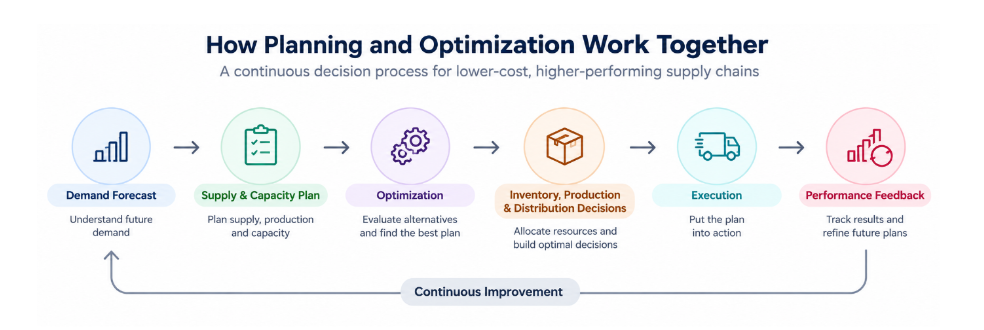
This creates an important shift:
Instead of asking “Can we meet demand?”, businesses can ask “What is the optimal way to meet demand?”
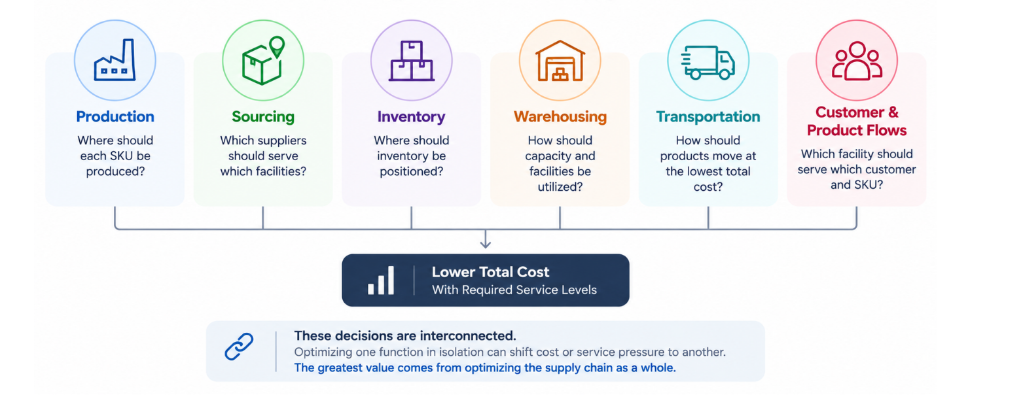
Consider a consumer goods manufacturer operating three plants and four distribution centers with hundreds of SKUs.
The company has a monthly demand and supply plan, but management wants to reduce total supply chain cost without reducing its 95% service target.
The optimization model evaluates several decisions together:
Which plant should produce each SKU?
Which suppliers should serve each plant?
Which DC should serve each customer region?
Where should inventory be positioned?
Which transportation options should be used?
The resulting solution might shift certain SKUs between plants, change supplier allocations, reposition inventory, and alter customer flows.
No single change creates the entire saving.
The savings come from finding a better combination of decisions across the supply chain.
This is the difference between optimizing individual functions and optimizing the system as a whole.
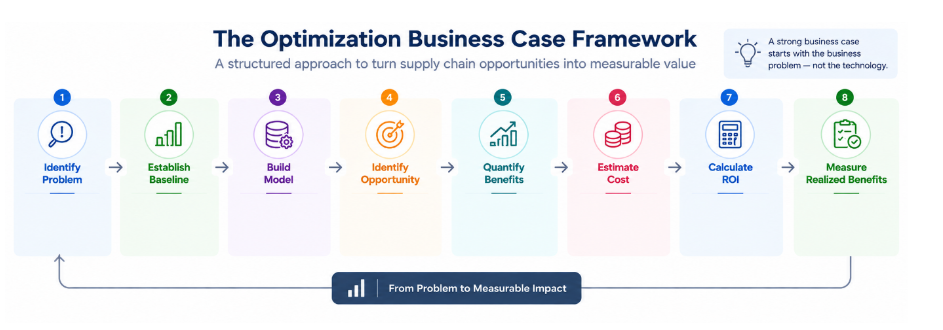
A practical optimization process typically follows seven steps:
This process turns optimization from a one-time analysis into part of the planning cycle.
Supply chain plans are built on assumptions and those assumptions can change.
What if demand increases by 20%?
What if a supplier loses capacity?
What if transportation costs increase?
What if production capacity changes?
What if a customer requires a higher service level?
Scenario analysis allows planners to test these possibilities before they affect operations.
A Digital Twin can extend this capability by providing a maintained virtual representation of the supply chain where alternative scenarios can be modeled and evaluated before changes are made in the real network.
The objective is simple:
Don’t wait for the supply chain to change. Test what happens when it does.
Optimization is most valuable when it is embedded into the planning process rather than used only when something goes wrong.
A traditional cycle might look like:
Plan → Execute → Problem → Replan
A more optimized process looks like:
Plan → Optimize → Execute → Measure → Re-optimize
The difference is important.
Optimization becomes a regular decision-making capability rather than a separate project conducted when the supply chain is already under pressure.
AI can support the optimization lifecycle in three important areas.
Data Intelligence
Planning and optimization depend on reliable data. AI can help identify missing values, anomalies, inconsistent master data, and other issues before they affect the model.
Modeling Intelligence
AI can help translate business questions into scenarios and models.
For example:
“What happens if we increase production capacity at Plant A by 15%?”
AI can help interpret the request, apply relevant business rules and constraints, and prepare the scenario for analysis.
Decision Intelligence
Optimization can generate complex results, but decision-makers need to understand why one solution is better.
AI can help explain cost drivers, compare trade-offs, identify opportunities, and communicate recommendations in business language.
Measuring the Value of Optimization
Optimization should ultimately be measured by the business value it creates.
Financial Metrics
Operational Metrics
The most useful comparison is often:
Current Plan vs. Optimized Plan
This allows the organization to quantify not only potential cost savings but also the operational trade-offs required to achieve them.
This connects optimization results to measurable business outcomes and helps distinguish theoretical savings from value that can be realized..
At Lambda Lab, our supply chain optimization software brings planning inputs, network modeling, optimization, scenario analysis, and decision intelligence together through five connected steps:
Model
Build a detailed representation of the supply chain, including demand, facilities, products, flows, and constraints.
Optimize
Evaluate possible decisions to identify optimal solutions against defined objectives.
Simulate
Test alternative demand, capacity, sourcing, inventory, and transportation scenarios.
Compare
Evaluate the impact across cost, service, inventory, capacity, and other business measures.
Decide
Select the solution that best aligns with the business objective.
Lambda Lab supports large-scale supply chain models, including SKU-level complexity, and combines optimization, simulation, and scenario analysis to help teams evaluate network and supply chain decisions. (Lambda Supply Chain)
Supply Chain Planning and Optimization are not competing capabilities.
Planning determines what the supply chain needs to accomplish. Optimization determines how to accomplish it as efficiently as possible.
When optimization is applied across sourcing, production, inventory, transportation, and distribution, organizations can move beyond functional cost reduction and improve the economics of the supply chain.
The objective isn’t simply to create a feasible plan.
It’s to create an optimal plan one that meets demand, respects real-world constraints, and delivers the best overall business outcome.
Plan with clarity. Optimize with intelligence. Execute with confidence.