
Ready to Transform Your Supply Chain Network?
Contact us today to learn more about how our Services can drive success for your business.
Lambda Supply Chain Listed as a Representative Vendor in Gartner® Market Guide for Supply Chain Network Design Tools
Published Oct 2026
Subscribe to receive latest resources on supply chain design
How a clean-sheet approach can help businesses determine where facilities should go, how many they need, and what the network could look like before existing decisions become constraints
When companies enter a new market, expand their footprint, or fundamentally rethink their supply chain, one question comes first:
If we were designing the network today, where would we put our facilities?
The obvious answer might be to look at the existing network and add a warehouse where capacity is needed.
But that approach starts with yesterday’s decisions.
Existing facilities, contracts, supplier relationships, and operating practices can all influence what a company considers possible. Sometimes the better starting point is to removes or relaxes existing network constraints and ask what the network should look like from scratch.
That is the idea behind Greenfield Analysis.
Greenfield Analysis is a strategic method for evaluating where new facilities should be located and how many may be required, assuming the network can be designed without being constrained by the existing facility footprint.
Greenfield Analysis is closely related to facility-location analysis, but it can go beyond simply finding a geographic center. Depending on the approach, it can consider demand, service requirements, capacity, transportation, cost, and other network constraints.
The core question is simple:
What would the supply chain network look like if we could start again?
That makes Greenfield Analysis particularly useful when the business is:
The resulting network is not necessarily the final answer. In many cases, it becomes the starting point for detailed supply chain network design and optimization.
Every existing network carries history.
A facility may be in a particular location because of a decision made ten years ago. A supplier may have been selected for reasons that no longer apply. Customer demand may have shifted. Transportation costs may have changed.
Yet when redesigning the network, these historical decisions can become implicit constraints.
Greenfield Analysis helps create a reference point:
What is possible without those legacy assumptions?
This can reveal whether the current footprint is broadly aligned with where demand exists or whether the business is operating around structural inefficiencies.
Greenfield therefore isn’t about ignoring reality.
It is about first understanding the ideal, and then determining how to move from the current state toward it.
A facility cannot be evaluated by geography alone. Demand, service requirements, transportation, capacity, operating cost, supplier access, growth, and risk can all influence whether a location makes sense.
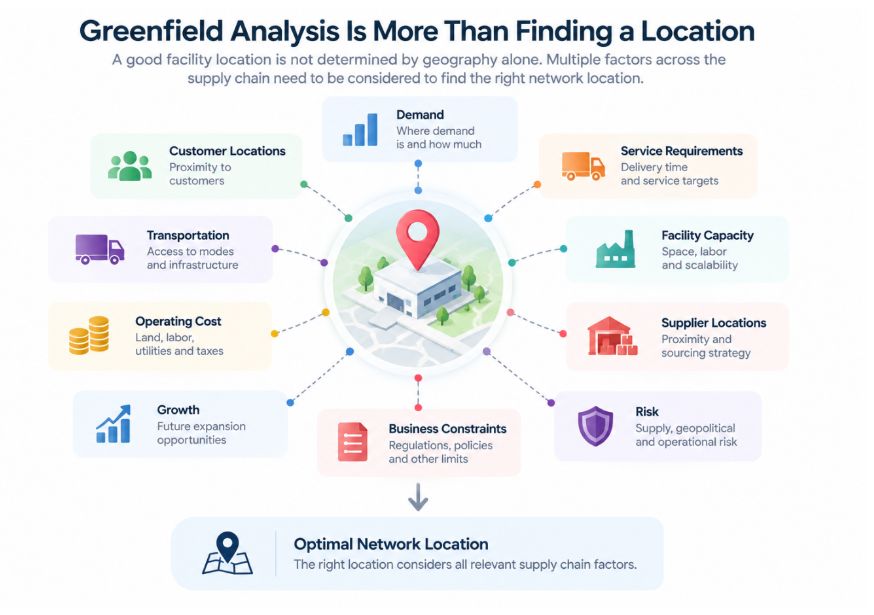
The right location is the one that works within the broader network not simply the one closest to demand.
Greenfield and Brownfield analysis answer different questions.
| Greenfield Analysis | Brownfield Analysis |
Starting point | Clean sheet | Existing network |
Main question | What should we build? | How should we improve what we have? |
Primary output | Ideal/reference network | Achievable optimized network |
Greenfield shows what the network could look like. Brownfield shows what can realistically be achieved from the current state.
Consider a consumer goods company entering a new market.
The company expects demand across hundreds of customer locations but currently has no distribution network in that region.
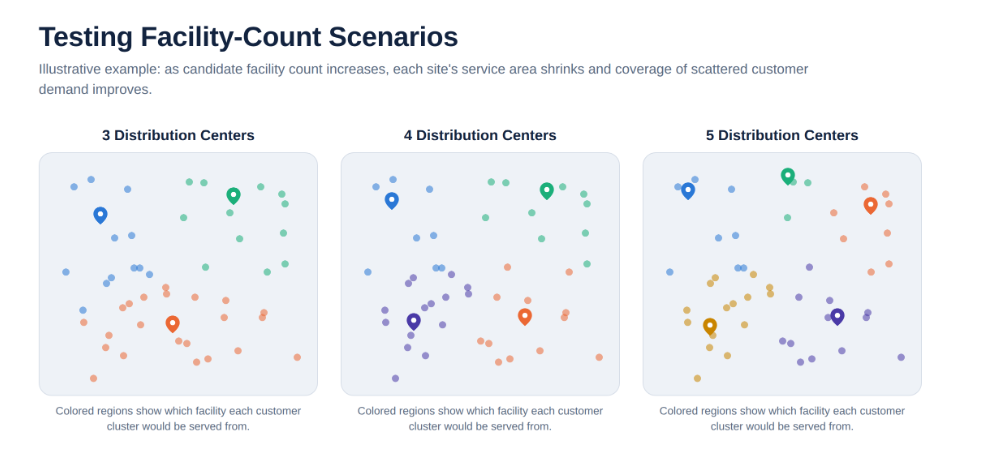
Management is considering building three, four, or five distribution centers.
Instead of choosing locations based on experience alone, the company models customer demand and service requirements across potential locations.
The analysis evaluates:
How many facilities are needed?
Where should they be located?
Which customers should each facility serve?
The results provide an ideal reference network.
That network can then be taken into a detailed Network Design model to evaluate SKU flows, customer allocation, capacity, inventory, sourcing, and transportation.
This two-stage approach helps avoid a common mistake:
Choosing a facility first and discovering its network implications later.
Greenfield Analysis is most useful for new markets, major expansions, new facilities, or significant network transformations—when the question is:
The number of possible facility configurations can quickly become enormous.
A network with hundreds of potential locations and large volumes of customer demand creates far more combinations than a team can reasonably evaluate manually.
Modern supply chain network-design platforms can use mathematical optimization to evaluate these combinations quickly, identify candidate configurations, and then pass those results into more detailed network models.
Lambda Lab allows organizations to start with a clean-sheet network and evaluate potential facility configurations before committing to a physical footprint.
Lambda Lab’s supply chain network design software currently includes Greenfield Analysis alongside network modeling, sourcing optimization, capacity planning, inventory strategy, CapEx planning, cost-to-serve, and M&A analysis. It also supports detailed SKU-level network modeling.
A public Lambda Lab case study illustrates this broader approach: a $2 billion CPG company planning its US distribution footprint evaluated networks with two to seven DCs across potential locations, then used scenario simulation and optimization to identify a five-DC configuration balancing transportation and warehousing costs.
Every supply chain accumulates history.
Facilities are built, suppliers are selected, customer patterns change, and transportation economics evolve.
Greenfield Analysis provides an opportunity to step back and ask a different question:
If we were designing the network today, what would we build?
That clean-sheet perspective can reveal opportunities that are difficult to see when decisions are made around an existing footprint.
But Greenfield Analysis is not the finish line.
It is the starting point for a broader network-design process—one that can bring together facility locations, customer allocation, SKU flows, inventory, transportation, capacity, cost, and service.
Don’t start with the network you have. Start by understanding the network you need.
Contact us today to learn more about how our Services can drive success for your business.
We’re excited to discuss what problems you are facing and how can you make your existing supply chain more efficient by continuously designing it.